Deploying infrastructure by CI-CD

Mike's Notes

I need a way to automate cloud deployments to handle scaling. I had toyed with the idea of training Pipi to do it. But I read a great article on Medium about using Jenkins with Terraform on GCP.

Pipi could get the CMS engine to generate the configuration files in that case. Jenkins could execute them, with Terraform deploying open-source PIPI applications from GitHub to GCP and handling user-specific requirements. Well, that's a plan (plans do change !).

Hopefully, Pipi will be able to communicate with Jenkins via an API.

The rest of the article gives detailed instructions on how to do this. Jenkins and Terraform will work with and can be hosted on all the major cloud providers.

  • AWS
  • Azure
  • GCP
  • IBM
  • Digital Ocean

They can also be installed locally on 

Resources

References

  • Reference

Repository

  • Home > Ajabbi Research > Library >
  • Home > Handbook > 

Last Updated

17/05/2025

GCP-How to deploy your infrastructure with CI/CD pipeline using Terraform?

By: Sumit L
Medium: 10/02/2023

Jenkins is an open-source automation tool for Continuous Integration (CI) and Continuous Deployment (CD). It is a server-based system that runs in servlet containers like Apache Tomcat. Jenkins is one of the most used DevOps and other cloud-native tools, allowing developers to build, test and deploy software seamlessly.

Terraform is an open-source infrastructure as a code software tool that enables you to create, change, and improve infrastructure safely and predictably.

Git is a free and open-source version control system used to handle that handles small to massive projects efficiently. Git tracks changes in the source code, enabling multiple developers to work together on non-linear development.

In this tutorial, We will deploy our infrastructure (VPC and Subnet) with Terraform but with a CI/CD approach. We will basically integrate Terraform into a generic deployment pipeline. Simply put, We are asking Jenkins to perform terraform-related operations on behalf of humans and bring automation to make your life easier. So, you will write a code in your local machine and push these codes to the source repository GitHub. The Jenkins server (which is running in Google Cloud) will fetch this repo, perform automation and deploy your infrastructure in GCP. Refer to the below diagram, and let’s get straight on to the demo.


... continued

Pipi 9 (2023-2026)

Mikes Notes

Here are my summary notes on building Pipi 9. More details are provided in related blog posts.

Resources

References


Repository

  • Handbook > Company > History

Last Updated

29/03/2026

Pipi 9 (2023-2026)

By: Mike Peters 18/12/2023

Mike is the inventor and architect of Pipi and the founder of Ajabbi.

By the end of last year (2022), Pipi 8 was ready for another architectural transformation. The successful adoption of global namespaces made any internal structure possible.

Big chunks of the internal engines were then aggregated into complex systems. Some had up to 20 engines, all operating independently and interacting. These systems were then combined into more extensive systems, etc. So far, there are 300+ engines, and Pipi 9 has emerged.

CMS

Pipi was still headless, and the self-documentation engine was broken when Pipi 8 was built out of 7. The only way I could test 8 was by using batch files and reading the logs.

It was time to fix the system's self-documentation. The CMS was rebuilt, and templates were added to automatically create a series of linked Wiki (like Wikipedia articles and a set of classically framed "PipiDocs" (a bit like JavaDocs).

The next stage enables direct editing of the parameters of the underlying systems, which the Wiki and Docs pages then self-document—a reverse loop of sorts.

1200 static Wiki web pages were rendered in 7 seconds. I was surprised by how fast it was. The Wiki and Docs are also cross-linked.

My friend Alex Shkotin from the Ontolog Forum helped me develop good self-documentation templates.

UI

Next, put a User Interface (UI) on the front end.  The problem here to solve was creating a UI generator based on User Interface Description Language (UIDL).

The CAMELEON References Framework (CRF) was chosen because of its rich history in EU-sponsored research, much of which was led by Professor Jean Vanderdonckt in Belgium. I specifically used usiXML but intend to grab good ideas from XUL, XAML, WasabiXML, etc.

CRF has three layers: Abstract UI, Concrete UI and Final UI. I added two more layers: a Locale UI and a Personalisation UI. CRF was initially meant to run both ways. I made it generative only, driven by DDD workflows.

Now, the UI generator process is;
DDD > Wfl > AUI > CUI > FUI > LUI > PUI
It sounds complicated, but it is robust, efficient and runs less often.

CRF, usiXML, etc., were mainly developed before CSS. Adding CSS and Design Tokens solves many problems.

By doing this, I could add all Unicode scripts and all 7,000+ languages in ISO 639-3 maintained by SIL International. This was tested by importing the UI string libraries for 6 languages from the Media Wiki translation effort.

Volunteers are testing the UI with Braille Devices for the Deaf-Blind, Screen Readers, Irlen's, Colour Blindness, Dyslexia, Epilepsy, etc., and it is underway.

Summary

  • A complex adaptive system emerges capable of learning, evolving, and replicating.
  • Primitives are also linked to the layer just below any top ontology
  • Power-law behaviours and fractal patterns were observed in the logs.
  • BORO in reverse feeds ontologies to the entity engine
  • Top-level ontologies become subjective world-views
  • UIDL (Chameleon) rendered UI with workflows, accessibility and i18n
  • Design tokens
  • Self-documentation fixed
  • 4Dism is used for space-time
  • CMS rebuilt to enable user customisation
  • Workflow patterns
  • Generic digital twin
  • Rules as code
  • The server is "trained" to produce SAAS applications
  • Optimised for DevOps teams and Mission Control
  • Automated self-tests using feature flags and canaries.
  • Embedded databases
  • UI can now use all human languages (269-3) and writing scripts (Unicode).
  • Testing by volunteers begins.

George Ellis and Emergence

Mike's Notes

Prof George F. R. Ellis is a South African Physicist. He has written the most straightforward explanations about complexity and emergence. I have used his explanations to build, test, understand, and enable Pipi's self-documentation.

All of the links to his pages at the University of Cape Town are broken, so the corrected links are below.

Update 12/06/2026

I'm currently synthesising Prof George F. R. Ellis's work on Emergence with that of Dr Alex Nugent (Knowmn) on Dissipative Structures and, eventually, with Prof Terrence Deacon's (Berkeley) on Teleodynamics to roll into the Gödel Machine that is Pipi 9.

Resources

References

  • The universe around us: An integrative view of science and cosmology.

Repository

  • Home > Ajabbi Research > Library > Authors > George F. R. Ellis
  • Home > Handbook > 

Last Updated

12/06/2026

George Ellis and Emergence

By: Mike Peters
On a Sandy Beach: 17/12/2023

Mike is the inventor and architect of Pipi and the founder of Ajabbi.

"George Francis Rayner Ellis, FRS, Hon. FRSSAf (born 11 August 1939), is the emeritus distinguished professor of complex systems in the Department of Mathematics and Applied Mathematics at the University of Cape Town in South Africa. He co-authored The Large Scale Structure of Space-Time with University of Cambridge physicist Stephen Hawking, published in 1973, and is considered one of the world's leading theorists in cosmology. From 1989 to 1992, he served as president of the International Society on General Relativity and Gravitation. He is a past president of the International Society for Science and Religion. He is an A-rated researcher with the NRF.

Ellis, an active Quaker, was a vocal opponent of apartheid during the National Party reign in the 1970s and 1980s, and it was during this period that Ellis's research focused on the more philosophical aspects of cosmology, for which he won the Templeton Prize in 2004. He was also awarded the Order of the Star of South Africa by Nelson Mandela in 1999. On 18 May 2007, he was elected a fellow of the British Royal Society." - Wikipedia

Websites

The universe around us: An integrative view of science and cosmology

Talks

On the Nature of Cosmology Today (2012 Copernicus Centre Lecture)

Close to the Truth - Is Emergence Fundamental (April 2022)

Books

  • (1993). Before the Beginning: Cosmology Explained. Bowerdean/Marion Boyars.
  • Lanza, A.; Miller, J. (1993). The Renaissance of General Relativity and Cosmology (2005 paperback ed.). Cambridge: University Press.
  • (1994). Science Research Policy in South Africa. Royal Society of South Africa.
  • Murphy, Nancey (1996). On The Moral Nature of the universe: Cosmology, Theology, and Ethics. Fortress Press.
  • Wainwright, John, eds. (1997). Dynamical Systems in Cosmology. Cambridge: Cambridge University Press.ISBN 978-0-521-55457-2.
  • Coles, Peter (1997). Is The Universe Open or Closed? The Density of Matter in the Universe. Cambridge Lecture Notes in Physics, vol. 7. Cambridge: University Press. ISBN 978-0-521-56689-6.
  • ed. (2002). The Far Future Universe: Eschatology from a Cosmic Perspective. Templeton Foundation Press. ISBN 978-1-890151-90-4.
  • (2004). Science in Faith and Hope: an interaction. Quaker Books.
  • (2004a). Science and Ultimate Reality: Quantum Theory, Cosmology and Complexity. Cambridge: University Press. ISBN 978-0-521-83113-0.
  • (2006). Handbook in Philosophy of PhysicsElsevierISBN 978-0-444-53002-8.
  • Maartens, Roy; MacCallum, Malcolm A. H. (2012). Relativistic Cosmology. Cambridge: University Press.
  • (2016). How Can Physics Underlie the Mind? Top-Down Causation in the Human Context. Springer.
  • Papers

    Ellis has over 500 published articles, including 17 in Nature. Notable papers include:

    John Henry Holland

    Mike's Notes

    John H. Holland's books and recorded seminars have significantly influenced PIPI's internal architecture, especially the incorporation of genetic algorithms.

    I also learned 2 key clues that I implemented. Noise injection should be around 0.5%, and 2,000 - 3,000 cycle iterations are necessary before an adaptive response to the environment emerges.

    Resources

    References

    • Reference

    Repository

    • Home > Ajabbi Research > Library > Authors > John Henry Holland
    • Home > Handbook > 

    Last Updated

    17/05/2025

    John Henry Holland

    By: Mike Peters
    On a Sandy Beach: 15/12/2023

    Mike is the inventor and architect of Pipi and the founder of Ajabbi.

    From Wikipedia


    John Henry Holland (February 2, 1929 – August 9, 2015) was an American scientist and professor of psychology, electrical engineering, and computer science at the University of Michigan, Ann Arbor. He was a pioneer in what became known as genetic algorithms. ...

    "Holland is best known for his role as a founding father of the complex systems approach. In particular, he developed genetic algorithms and learning classifier systems. These foundational building blocks of an evolutionary optimisation approach are now included in all texts on optimisation and programming."[6]Carl Simon, professor of mathematics, economics, complex systems and public policy

    Holland was a member of the Board of Trustees and Science Board of the Santa Fe Institute ...

    His books include

    • Adaptation in Natural and Artificial Systems (1975, MIT Press)
    • Hidden Order: How Adaptation Builds Complexity (1995, Basic Books); reviewed by Mark S. Miller in Reason
    • Emergence: From Chaos to Order (1998, Basic Books)
    • Signals and Boundaries: Building Blocks for Complex Adaptive Systems (2012, MIT Press)
    • Complexity: A Very Short Introduction (2014, Oxford University Press)

    Dave McComb on the Data-Centric Revolution

    Mike's Notes

    TDAN has published an excellent series of articles on data and architecture in large systems written by Dave McComb.

    Resources

    • Resource

    References

    • Reference

    Repository

    • Home > Ajabbi Research > Library > Authors > Dave McComb
    • Home > Handbook > 

    Last Updated

    17/05/2025

    Dave McComb on the Data-Centric Revolution

    By: Dave McComb
    TDAN: 10/12/2023

    Mike is the inventor and architect of Pipi and the founder of Ajabbi.


    Dave McComb is President and co-founder of Semantic Arts, Inc., a Fort Collins, Colorado-based consulting firm. Since its founding in 2000, Semantic Arts has remained 100% focused on helping clients adopt Data-Centric principles and implement Enterprise Knowledge Graphs. Semantic Arts has 30 employees in three countries and is currently helping ten highly visible Fortune 500 companies adopt Data-Centricity. In 2022, Semantic Arts was named a Colorado Company to Watch.

    Articles published on TDAN

    Dave is the author of 

    WholeCellViz

    Mike's Notes

    WholeCellViz is a web-based software program for visually analysing whole-cell simulations. Pipi's internal architecture uses many of the same techniques.

    Resources

    References

    • Reference

    Repository

    • Home > Ajabbi Research > Library >
    • Home > Handbook > 

    Last Updated

    17/05/2025

    WholeCellViz

    By: 
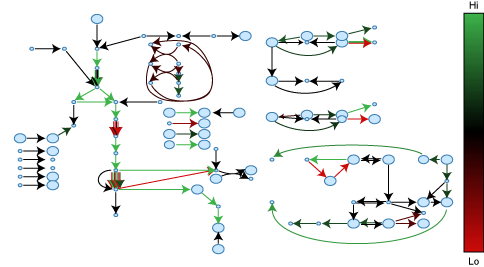
    WholeCellViz: 02/12/2023