Showing posts with label Quanta. Show all posts

How Is Science Even Possible?

Mike's Notes

Note

Resources

References

  • Reference

Repository

  • Home > Ajabbi Research > Library > Subscriptions > Quanta Magazine
  • Home > Handbook > 

Last Updated

17/05/2025

How Is Science Even Possible?

By: Steven Strogatz
Quanta Magazine: 20/06/2024

How are scientists able to crack fundamental questions about nature and life? How does math make the complex cosmos understandable? In this episode, the physicist Nigel Goldenfeld and co-host Steven Strogatz explore the deep foundations of the scientific process.

The universe seems like it should be unfathomably complex. How then is science able to crack fundamental questions about nature and life? Scientists and philosophers alike have often commented on the “unreasonable” success of mathematics at describing the universe. That success has helped science probe some profound mysteries — but as the physicist Nigel Goldenfeld points out, it also helps that the “hard” physical sciences, where this progress is most evident, are in major ways simpler than the “soft” biological sciences.

In this episode, Goldenfeld speaks with co-host Steven Strogatz about the scientific importance of asking the right questions at the right time. They also discuss the mysterious effects of “emergence,” the phenomenon that allows new properties to arise in systems at different scales, imposing unexpected order on cosmic complexity.

Transcript

STEVEN STROGATZ: Albert Einstein once wrote, “The eternal mystery of the world is its comprehensibility.” It really is awesome when you think about it. The laws of nature, at least in physics, turn out to be amazingly simple. So simple that we human beings can discover those laws and understand them and use them to change the world.

But why is nature like this? Why is it so comprehensible? And why is math so uncannily effective at explaining it, not just in physics, but also in chemistry, in astronomy, and even in some parts of biology? In short, why is science even possible?

I’m Steve Strogatz and this is “The Joy of Why,” a podcast from Quanta Magazine, where my co-host, Janna Levin, and I take turns exploring some of the biggest mysteries in math and science today. In this episode, we’ll be speaking with physicist Nigel Goldenfeld about the mystery of nature’s comprehensibility.

Nigel holds the Chancellor’s Distinguished Professorship in Physics at the University of California, San Diego, where his research spans condensed matter theory, the theory of living systems, hydrodynamics and non-equilibrium statistical mechanics. Previously, he was a professor at the University of Illinois at Urbana-Champaign, and a founding member of its Institute for Genomic Biology, where he led the biocomplexity group and directed the NASA Astrobiology Institute for Universal Biology. In addition to being a fellow of the American Physical Society, the American Academy of Arts and Sciences, and the U.S. National Academy of Sciences, Nigel is also well known for authoring one of the standard — and I have to say, terrific — graduate textbooks in statistical mechanics.

Nigel, thanks so much for coming on the show.

NIGEL GOLDENFELD: Oh, it’s a pleasure to be here, Steve.

STROGATZ: Yes, it really is a pleasure for me. I am curious where we’re going to go with this. It’s such a really very profound philosophical question, this Einstein quote about nature’s comprehensibility, but I wonder what you think of it? I mean, let’s talk about both parts of it. Is the world really comprehensible, at least to some degree? And if it is, does that strike you as mysterious?

GOLDENFELD: So I think it’s a wonderful quote, and certainly one that inspired me, and I’m sure other people thinking about the research that we do. And I think the reason it’s important is because we’ve grown physics to such an extent that it now starts to impinge on other disciplines. You mentioned biology, but also, you know, I could mention economics and atmospheric sciences, climate change, all these sorts of things.

And as you start getting into these much more complex and complicated areas of science, you wonder how were we even able to do anything in physics, let alone these other things. And in fact, the reason these other fields are difficult is something that’s also not clear. You know, you could also ask what is the reason for the unreasonable ineffectiveness of mathematics in biology.

[STROGATZ laughs]

GOLDENFELD: When you start to think about it, you realize that when we talk about the effectiveness, we’re talking about problems where we’ve been lucky to make an impact. And so our sample is skewed.

We have a lot of successes in science. Some of the most accurate things that we know in science are in physics. You could say, “Well, that’s because, you know, we only talk about those problems, because those are the ones that actually worked. All the many other things that we try to do failed dismally, and we never ask about those. And our sample is somewhat biased.”

STROGATZ: Well, that’s great, this point that you’re making that we’re sort of assuming facts not necessarily in evidence here in saying that the world is comprehensible. Because as you say, there are these parts of science that we still have yet to really figure out — economics, parts of atmospheric science and so on.

So for listeners who aren’t necessarily following what we’re talking about here, think about the example from the 1850s or ’60s: James Clerk Maxwell figuring out the equations for how electricity and magnetism work.

It’s just four little equations that nowadays fit on a T-shirt — physics and math nerds like me and Nigel and maybe even you like those T-shirts. What’s crazy is that you can really understand almost everything there is to know about electricity and magnetism with the help of those equations and some clever math.

For instance, Maxwell himself figured out that a prediction from those equations is that something called electromagnetic waves could exist. And today, those are the basis for wireless communication, technology that we all use every day in our cell phones.

And so the question is: How is it possible that we, with our puny primate brains, can figure out these four equations that are so marvelous? And is it, as you suggested, Nigel, just that we’re asking questions whose answers are likely to be simple and ignoring the really hard ones? Or, I don’t know, how should we think about this? How is it possible Maxwell could have come up with these equations?

GOLDENFELD: Let me take another example, which is Einstein’s prediction of gravitational waves — which has been in the news a lot in the last couple of years. The story is that Einstein had this idea of thinking about somebody falling in an elevator. And they realized that the falling in an elevator is similar to what you get from gravity.

And so they came up with a principle of equivalence. And from that very, very slender insight, translated into mathematics through Riemannian geometry and tensor calculus and so on, which Einstein had to learn in order to do that, he was able to create this amazing mathematical edifice, which we call the general theory of relativity today, which is actually the theory of gravitation.

And it explains gravitation to a higher accuracy than Newton’s law of gravitation, and makes numerous predictions, of which the gravitational waves are one of the most spectacular. So that’s another fantastic example.

And it just boggles the mind that somebody could imagine that and create the science that makes these predictions. And, you know, a hundred years later using astonishing technology, we’re able to actually observe these things.

STROGATZ: It is. It seems almost like a miracle. It’s something that the physicist Eugene Wigner, in a famous essay in 1960, posed [as] “the unreasonable effectiveness of mathematics in the natural sciences,” and you already alluded to this phrase of his. What is unreasonable about it?

GOLDENFELD: So you and I have been talking about new qualitative phenomena that you predict, for example, from Faraday’s law and all these things that Maxwell had to work with. That’s one thing that’s very important about science, is that we can predict things that you would otherwise not expect.

But the unreasonable effectiveness that Wigner is talking about is the accuracy with which it makes those predictions.

So here’s another example. You look at, say, the quantum mechanics of an atom interacting with Maxwell’s electromagnetic field. When you take electromagnetic field, you apply quantum mechanics to the interaction of that with an atom. You’re able to make predictions to something like 10 decimal places of accuracy. And those agree with experiments to all significant figures that the experiments, in theory, are applicable for. And that’s astonishing. And I think Wigner and Einstein wanted to know how could it be that such very simple mathematics has such great explanatory power.

And people may say, ”Well, what do you mean it’s simple? You know, Einstein’s theory of relativity, general theory of relativity, is one of the most complicated pieces of mathematical physics that you can learn.” And that’s true.

But the physical insight that goes into it is literally very simple. Just, acceleration is literally like a gravitational force. And then being able to turn that into a mathematical equation, which you can then make simple predictions from, is really where the beauty and the amazingness lies. So, I think that’s one aspect of it.

There’s another thing, though, that is not talked about very much, which is that this idea that mathematics and physics is so powerful in its explanations makes another assumption. That assumption is reductionism.

This goes back to another quote of another founder of modern physics, Paul Dirac, who wrote down the relativistic wave equation, an equation that describes quantum mechanics connected with special relativity — it’s called the Dirac equation. And he rather arrogantly wrote that his equation describes most of physics and all of chemistry.

[STROGATZ laughs]

GOLDENFELD: And his idea is that basically — and it’s the same idea that motivates what today we call high-energy physics, but in an era with more bravado would be called elementary particle physics.

And there was the idea that you can just find the elementary building blocks of matter. And then once you’ve got those, all you have to do is put them together and you’ve explained everything in the world. And we know that that’s not true. And that’s the sort of fundamental insight that came out of physics around about 1950 or so. Led to the birth of what’s known as condensed matter physics, and is certainly operative on steroids when you look at biological phenomena, where just knowing the basic forces between atoms doesn’t explain, you know, why you can think.

So when we talk about the effectiveness, we’re talking about the effectiveness on very simple problems.

STROGATZ: Hmm, interesting distinction. So just to review some of these examples again to make sure I’m with you. With Maxwell, his equations, not so simple unless you know vector calculus or something equivalent. But then once you know that math, as I tried to emphasize, it’s just four little equations that can fit on a T-shirt. So simple in that way, and simple principles going into them.

But then your point seems to be, yes, but you can only predict simple phenomena like a propagating wave through a vacuum, whereas really complicated stuff, say, predicting patterns of thought in a human mind — I mean, this is the tricky part.

In principle, do we believe that it is actually somehow in the physics, but we just can’t figure out how to do the math to show phenomena like consciousness and emotion and all that? Or is there something else than what the physical laws imply?

GOLDENFELD: Well, I think there is. And this goes back to the question of why it is that we can do science at all.

If you truly believe that to understand, say, the phenomenon that we see in biology, you can get all of that, say, from Dirac’s equation or, you know, quantum mechanics and so on, then every time you try to understand something quantitatively — in biology or solid state physics, for example — you know, you’d have to worry about the radiative corrections to the mass of the top quark. And none of us think that all of those things that happen at such small scales inside a nucleon at very high energies have anything to do with, you know, why a bird can fly or stuff like that.

The fact that we can do science tells us that somehow these scales get separated through something which we typically call emergence. The great benefit of that is that we don’t have to solve everything all the way down in order to understand something.

STROGATZ: Interesting. So you’re saying worrying about quarks isn’t going to tell us anything about the behavior of the stock market tomorrow. We can somehow… It’s like, as if different scales in nature are insulated from each other, or something like that. What’s the language you would use? You spoke of separation.

GOLDENFELD: I talked of separation and I talked about emergence. And I’d like to give you another example of that which is very different from the one that people like Einstein and Wigner and Dirac and so on would’ve used, and they wouldn’t even have known about it.

So there’s a phenomenon in nature called a phase transition. The simple example is, you take a lump of ice and heat it up, and eventually it’ll melt into liquid. So it’ll go from the solid phase into the liquid phase. And then from there, if you heat it up further, it’ll go into the gas phase.

And another example would be if I took a magnet and I heated it up. It turns out that above a certain temperature, a magnet will stop being magnetic. There is a theory of that transition, the magnetic transition, and other transitions which are like it, such as how materials become superconducting and very exotic things like that. But the most interesting thing about the transition is that we can understand it using a branch of physics called “renormalization group theory.” And I’m not going to go into the technicalities of it, but what the theory predicts is that if you measure how magnetic something is very close to the temperature where it first becomes a magnet, whilst also applying a magnetic field, you get a certain magnetization that you can measure as a function of temperature and external magnetic field.

And you can do this for any magnet that you’d like. But it doesn’t really matter what the atoms are. And if you take the data and process it in a certain way, what you find is the results are the same for every single magnetic material. It doesn’t matter what it is. As you go just below the temperature where it first becomes magnetic, you find that it obeys a certain equation. And that equation is exactly the same for every material. And not just exactly the same: All the data from all the different magnetic materials, they all lie on one curve. And physicists call this universality. We completely understand that.

Now, the other thing is amazing, though, is that we can make a theoretical prediction about what that curve should be if you process the data in the way that the theory tells you to do it. And when you take the data and you take the theoretical curve, it falls exactly on the experimental data.

OK, so that’s fantastic. This model of what a phase transition is is very successful and obviously extremely accurate. Not only does it predict this universality, but it also predicts exactly not just a number, but a whole function.

And it’s a whole relationship that you can measure experimentally. So that’s true. And I like to say that it’s not really true that the model has given a precise prediction in agreement with experiment. It’s really a model of a model of a model of a model.

STROGATZ: [laughs] OK, what?

GOLDENFELD: Yeah. OK.

STROGATZ: You better explain that.

GOLDENFELD: Yes. A model of a model of a model of a model. So, so why is that? Well, so suppose you said to a scientist, OK, make a theory for me of a magnet. So they’d say, well, a magnet is made out of atoms. So in order to understand atoms and how they interact and become magnetic, I need to worry about the electrons on the atoms. I need to worry about the magnetic moments of those atoms. And so I make a model of the material based on quantum chemistry.

But that model is unimaginably complicated, and it gives you no hint that there could be something that doesn’t depend on atoms in it. Because the model itself is very specific to the particular atoms.

So then you say, well, really, that’s way too hard. Maybe a quantum chemist could simulate this and make a prediction. And if they did that, they would see that the prediction did agree with what you see experimentally, and does agree with what the theory predicts. But that’s a very huge computer calculation.

So then you say, let’s simplify it. Let’s just not worry about the atoms too much. Let’s just worry about how the electrons move around in the material. So you go ahead and do that, and you find you’ve got a complicated model of electronic structure.

STROGATZ: Sorry let me interrupt for a second, just to make sure that this whole model of a model thing is clear. So there was the real magnet, then there was the quantum chemistry model of the magnet, then there was the electronic structure model of the quantum chemistry model.

GOLDENFELD: Yes, well, now we’re going to go to the quantum Heisenberg model of the magnetic moments of the electrons inside the electronic structure, which came from the quantum chemistry. And that model is too hard.

So you say, OK, well, let’s throw away quantum mechanics. We’ll just make it classical. So you do that, and the model is still too complicated. So then you say, well, let’s take the thermodynamics, which is what everything depends upon in any case, and let’s do some kind of expansion of that. And that’s a model where you can finally do a calculation.

As you said, you’ve got one, two, three, four, five models of a model of a model of a model of a model of this material. And at each step along the way, you have made an approximation that would be rejected from every physics journal. Because everybody would say, “That’s approximation you can’t justify. There’s no small quantity. No idea what you’re talking about. How can that possibly work?”

STROGATZ: I must also say that here in the math department, you know, people would be hysterical

GOLDENFELD: Oh, yes. Oh, yes. They would be horrified. But the joke’s on them. Because, at the end of the day, you do this whole procedure, and then you find you make a prediction with no adjustable parameters, and it agrees precisely with experiment.

STROGATZ: Dun, dun, dun. [laughs]

GOLDENFELD: Dun, dun, dun. Every step along the way, the approximations you’re making are not systematic and not justifiable, at least ahead of time. And that, I think, is a fantastic way to articulate this mystery that you’re alluding to.

STROGATZ: Hmm, that is a marvelous exposition. I didn’t imagine this ahead of time while preparing for this interview, but I love it. And I think you’re really capturing the mystery. It’s like we have no right for this to work as well as it does. It’s as if nature is somehow acting in a very forgiving or convenient or cooperative manner for us. Like it’s helping us get lucky or something.

GOLDENFELD: Well, that’s the thing. This happens only under special circumstances. In this particular case, very close to a phase transition. So we understand how it works there. But these different levels of description that I alluded to, you know, all of these are different ways of describing something at different length and time and space scales. And as you go to each level, you kind of absorb all the complications of the level lower down into some parameter that is in the description that you’re talking about. And then once you’ve done that, you don’t need to worry about what happened below.

That, I think, is why we can solve this particular problem and why it works so accurately.

STROGATZ: We’re going to take a short break and we’ll be right back.

STROGATZ: Alright, welcome back. I’m speaking with Nigel Goldenfeld about how we can model complex phenomena — and how we manage to do it so accurately.

GOLDENFELD: So, when we talk about how we can do science at all, here is an example which says the only reason you can do this sort of calculation is because there’s these separations of scales and energy and time and space.

When you start talking about, you know, physics being successful, and biology or economics or social interactions and things like that. Can we expect to be able to do those things if there isn’t any obvious way that one can separate scales, and make sure that what happens at very small scales doesn’t affect what happens at large scales? And it may be that there’s some areas of science where that is not true. And then you may not be able to be successful in those things.

STROGATZ: Hmm. That’s an interesting point. I may be going off the rails here, but I’m thinking of something like economics, which you might want to think of as the byproduct of hundreds or thousands or millions of people and firms interacting through markets and so on. That it’s a kind of complex system, economics, where the smaller scale, the molecules or the atoms or the quarks are people making individual decisions that then aggregate into an economy or a market.

In your example, where the fussy behavior of the top quark doesn’t affect what’s happening to the birds flying overhead, here we might not have that separation. Like, individual decision makers can have an outsized impact on the economy? Is that the issue that makes economics so difficult or one of the issues?

GOLDENFELD: Yeah, I don’t know about economics per se, but I’ve given this some thought in terms in finance. So, finance is a very interesting example to think about emergence. So remember in finance, we have data. We know every single transaction that occurred. We know when it occurred, how much. We have every piece of information like that. And now the question is, can you make predictions based on it?

So let me give you an example. First of all, of course, we know that you can’t predict things very well, and not only can you not predict things into the future, you can’t even predict things into the past.

[STROGATZ laughs]

GOLDENFELD: So, there was a wonderful example of this, which was an event called the Flash Crash. Do you remember what that is?

STROGATZ: You should remind us. I’m not sure I remember when and what happened.

GOLDENFELD: On May the 6th, 2010, there was a trillion-dollar crash of the U.S. stock market. The Dow Jones plunged like a thousand points within a few minutes. And eventually it came back up again. And this was an unexpected event, and to this day, people aren’t really 100% sure what triggered that. It certainly wasn’t something that people expected at the time.

What actually happened, I believe, is that you have a cooperative phenomenon where a lot of people are doing algorithmic trading, they’re all more or less using the same signals to trigger their computer guided trades and I think the whole system just synchronized and crashed and eventually people had to stop the thing happening by pulling from the network and things like this. So this is an example of extreme sensitivity cascading through the system because of collective properties of the whole financial system, properties that nobody even knew were there.

STROGATZ: Hmm. Yeah, it’s interesting to hear you use the word “cascade,” because that comes up in connection with the power grid, where sometimes you’ll have an event like a lightning storm somewhere and then because, as you say, there’s this connectivity, in this case, through high voltage transmission lines in the power grid, you can get propagating failures.

So this does seem to be another example where a small-scale event can propagate and have consequences at a much broader scale. So is this the idea why maybe the hard sciences are the easiest?

GOLDENFELD: Oh, I always say that the hard sciences are the easiest. Yes, the reason physics is so successful is because we only ask very simple questions.

STROGATZ: So the supposed soft sciences are, in a certain sense, you would say then, the hardest?

GOLDENFELD: So you have to ask a question. You know, what is the purpose of science? What do we want to be able to predict? So, let’s go back to my example about the phase transition. I talked about this example of how you can look at the behavior of a magnet very close to the temperature where it becomes a magnet. And there’s a universal phenomena there, and we understand it exquisitely, and it’s wonderful and it’s amazing. So, the listener might get the impression that we understand everything about this and there’s nothing mysterious about it at all. But there is still one thing that I didn’t tell you. And that is this.

There is a temperature where every material becomes a magnet. But that temperature is different for each of the materials. And we don’t know how to predict that number very accurately. That number is not something that is universal, unlike the curve that I alluded to that tells you the response of a magnet.

That number depends on everything. All of the levels of description that I swept under the rug in order to explain what happens near a phase transition. All of those things come back to bite you when you want to know what is that actual critical temperature where the material first becomes a magnet.

STROGATZ: Hmm, interesting.

GOLDENFELD: So you have to ask the questions that you ask in science with an eye to saying, “First of all, let me ask the easy questions, the ones that don’t depend on too much. First I understand those things, and then later on we’ll get to the other ones.” And maybe never, but there’s a sort of rational order in which you, would ask questions. And so science in some sense, has to be realistic in what its goals are.

STROGATZ: Hmm, so then the resolution to our earlier question about why is science even possible, if I’m hearing you right, you’re suggesting that some things in nature could be described by the adage that you hear people say all the time, “Everything depends on everything else.” And some things in nature are not like that; not everything depends on everything else.

Am I on the right track there? That the ones where everything does depend on everything else are really going to be hard.

GOLDENFELD: Yeah. Yeah. And there’s no shortcut. And there’s other things where, if you ask the question in the right way, you can get an interesting answer, which is useful and it helps your understanding of the phenomena and so on. But if you want to know, you know, what the actual number is in degrees Fahrenheit, well, it’s not going to tell you that.

STROGATZ: Hmm. So then it seems like we’re coming to what some people might view as a disappointing cop-out of an answer, which is that science is possible because we restrict ourselves to the questions that have this kind of separation or an insulation that lets us do calculations where what’s happening here doesn’t depend on what’s happening out at Alpha Centauri.

And so it’s like we can answer the things that are easy in this sense, that they’re well separated. The others are just going to be hopeless forever? Is that the idea?

GOLDENFELD: Well, I don’t think it’s a cop-out. I think it’s a great advance to be able to say, “This question here, that’s an example of one of those things that you shouldn’t ask. And this question here is an example of one that you should.” So about 15 years or so ago, we came up with a theory that explains why there is one genetic code. It’s a general theory about the ability to express genes and make proteins and that’s what the genetic code is for, and also, by the way, it explains how life could have evolved so rapidly early on. So, it’s quite an interesting theory. And so often I’ll go and give a talk about this work, and people will ask me, “Well, why are there 20 amino acids of life?” OK? And I’ll say, “I haven’t a clue.”

[STROGATZ laughs]

GOLDENFELD: And so I think that’s an example of one of those questions that you shouldn’t ask. And I’ve got another reason for saying that. So the genetic code is literally a code book that goes from DNA — or actually, messenger RNA to amino acid, that then gets linked into a protein.

So it’s a kind of grammar, a language of molecular biology. So Francis Crick, who of course had with [James] Watson discovered the structure of DNA, wanted to try to understand why there are 20 amino acids in life. And he came up with an amazing and beautiful theory, which is mathematical. Can I tell you what the theory is? I don’t know if you know about it.

STROGATZ: So 20 amino acids, and there’s a theory for why 20?

GOLDENFELD: Yeah. So the theory is very simple. If you have a sequence of letters in threes — ACG, TAC, whatever, these correspond to certain nucleotides — you don’t know where the sequence starts. So really, whenever you read the genome, you should put commas in to tell you where the words start. So, Crick asked the question, ”Well, can you make a code so that if I’ve got four nucleotide bases, what is the largest number of amino acids you can code for so that every string in this code can make sense without you having to put in the commas?”

STROGATZ: It’s a very natural question, a beautiful question.

GOLDENFELD: It’s a beautiful question, and he came up with an answer. And the answer was that the largest number of amino acids you can get is 20. Hence, 20 amino acids of life. So then you can enumerate all of these codes without commas that Francis Crick had postulated. You can enumerate them. And when the actual genetic code was discovered by [Marshall] Nirenberg and others five or six years later, the actual code is not one of the ones that he had predicted. It’s completely wrong.

So, this is, if you like, the reasonable ineffectiveness of mathematics in biology. Because, in fact, the real code is a product of evolution. And there’s nothing special about the number 20.

So, this is an example of, you’ve got to ask the right question. You thought you could do science, biology in this case, using the same sort of elegant mathematical principles that are so powerful in physics, but you completely get egg on your face when you try them, without really understanding more about the scientific phenomena that are relevant in biology.

STROGATZ: And so would you generalize, then, to say that the role of history or evolution or contingency, those kinds of things, are another ingredient for why we might expect certain subjects to be difficult, or maybe not amenable to the elegance of math? Is that the issue?

GOLDENFELD: Well, it is, but it’s not completely hopeless. I mean, we did make a theory for the evolution of the genetic code, which did explain, you know, how is it that the world started 4.6 billion years ago? The last universal common ancestor of all life on Earth today was around 3.8 billion years ago.

So that means that in less than a billion years, life went from nothing to the architectural complexity of the modern cell. And then after that hardly evolved at all.

OK, so that is staggering. I mean, I don’t know, of course, the ultimate reason of how life evolved and so on, but at least when we made our theory of this, it explained why it evolves so rapidly, and it explained why the genetic code is so accurate and why there’s only one of them. So it explains some things, but not the other.

So we definitely understood — advanced in our understanding of basic science, but we were able to do that because we fully recognized, “Here’s a question that’s not going to be a good one to go after. Here’s a question that we might be able to do.” And I think one of the jobs of the scientist is to really ask the right questions in the right way. And that’s harder than it looks.

STROGATZ: Oh, that’s a very, very marvelous stopping point for us in a way, that part of the secret of science is the art of asking the right questions. There’s even a book with that name, isn’t there? Isn’t that Peter Medawar’s book, The Art of the Soluble?

GOLDENFELD: That’s right, but yes, I mean all science starts with asking questions. And if you don’t know how to ask questions, you can’t do science. Science is not the technology, the techniques of doing science. Of course, that’s how we’re able to do it, but fundamentally, it comes from asking questions.

STROGATZ: Probably a lot of our listeners are thinking: What about everything that’s going on today with machine learning, artificial intelligence, the possible existence of quantum computers that’s supposed to solve all kinds of problems once they really start to get serious?

Do you think that those kinds of technologies will help us deal with these intricately interwoven kinds of problems where everything or many things depend on each other, and we don’t have a good separation.

GOLDENFELD: Yes. Well, there’s two things I want to say about that. I’m really glad you raised that issue. So one of the things is the phenomenon of emergence. I mean, when people started building, you know, things like ChatGPT and so on, what those things are, are basically machines that can predict the next word. And nobody expected that those machines could pass the bar exam or medical exams or help people with their homework or help people write computer programs and so on. The range of applications has been staggering and a surprise even to the people who built these machines. And in fact, nobody really knows how they work.

In fact, if you look at the effectiveness of AI in solving problems, it also exhibits parallel relationships very much like the ones that you see in phase transitions. So one of the things I think is a great frontier for science is trying to understand how these machines are able to do so much more than what they were designed to do.

The other thing, where I think it’s important, is that what AI is very good at is discerning patterns in data, which are so complex that we don’t perceive as well as these machines.

So I think there’s great opportunity to use them to solve problems, which are very, very hard. The problem that I think is an ambitious problem I think could only be solved by using AI is trying to understand the origin of instinct. So how is it that instincts are coded in biological organisms? OK? We understand the genetic code and we understand how the proteins that go into living organisms, how they’re coded and so on.

But going from that level of description to the complexity of an organism like a fish that knows where to swim to in order to go to its breeding ground and seagulls and things like this. Clearly, we’ve somehow managed to encode very, very complex behavior. So this is something that reaches across all scales of living systems. And it’s hard for me to see, in principle, how something as complicated as instinct can be coded, but I think that AI would be able to perhaps be a tool that we could use to help us make a scientific discovery and not just, you know, build amazing technological machines.

STROGATZ: Hmm. Well, that is fascinating, Nigel. I knew it would be provocative and stimulating to talk to you and you’ve just, I think, demonstrated how, the art of science is asking good questions with that question you’ve left us with. So thank you. We’ve been speaking with physicist Nigel Goldenfeld. It has been a really great pleasure to talk to you today. Thank you.

GOLDENFELD: Thank you.

STROGATZ: Thanks for listening. If you’re enjoying “The Joy of Why” and you’re not already subscribed, hit the subscribe or follow button where you’re listening. You can also leave a review for the show — it helps people find this podcast.

“The Joy of Why” is a podcast from Quanta Magazine, an editorially independent publication supported by the Simons Foundation. Funding decisions by the Simons Foundation have no influence on the selection of topics, guests or other editorial decisions in this podcast or in Quanta Magazine.

“The Joy of Why” is produced by PRX Productions; the production team is Caitlin Faulds, Livia Brock, Genevieve Sponsler, and Merritt Jacob. The executive producer of PRX Productions is Jocelyn Gonzales. Morgan Church and Edwin Ochoa provided additional assistance. From Quanta Magazine, John Rennie and Thomas Lin provided editorial guidance, with support from Matt Carlstrom, Samuel Velasco, Nona Griffin, Arleen Santana and Madison Goldberg.

Our theme music is from APM Music. Julian Lin came up with the podcast name. The episode art is by Peter Greenwood and our logo is by Jaki King and Kristina Armitage. Special thanks to the Columbia Journalism School and Bert Odom-Reed at the Cornell Broadcast Studios.

I’m your host, Steve Strogatz. If you have any questions or comments for us, please email us at quanta@simonsfoundation.org..

[Theme fades out]

Quanta - The New Math of How Large-Scale Order Emerges

Mike's Notes

I can use this in the Machine Learning part of the Pipi 9 core.

Resources

References

  • Reference

Repository

  • Home > Ajabbi Research > Library > Authors > Phillip Ball
  • Home > Handbook > 

Last Updated

17/05/2025

The New Math of How Large-Scale Order Emerges By Philip Ball

By: Phillip Ball
Quanta Magazine: 10/06/2024

    The puzzle of emergence asks how regularities emerge on macro scales out of uncountable constituent parts. A new framework has researchers hopeful that a solution is near.

    A few centuries ago, the swirling polychromatic chaos of Jupiter’s atmosphere spawned the immense vortex that we call the Great Red Spot.

    From the frantic firing of billions of neurons in your brain comes your unique and coherent experience of reading these words.

    As pedestrians each try to weave their path on a crowded sidewalk, they begin to follow one another, forming streams that no one ordained or consciously chose.

    The world is full of such emergent phenomena: large-scale patterns and organization arising from innumerable interactions between component parts. And yet there is no agreed scientific theory to explain emergence. Loosely, the behavior of a complex system might be considered emergent if it can’t be predicted from the properties of the parts alone. But when will such large-scale structures and patterns arise, and what’s the criterion for when a phenomenon is emergent and when it isn’t? Confusion has reigned. “It’s just a muddle,” said Jim Crutchfield, a physicist at the University of California, Davis.

    “Philosophers have long been arguing about emergence, and going round in circles,” said Anil Seth, a neuroscientist at the University of Sussex in England. The problem, according to Seth, is that we haven’t had the right tools — “not only the tools for analysis, but the tools for thinking. Having measures and theories of emergence would not only be something we can throw at data but would also be tools that can help us think about these systems in a richer way.”

    Though the problem remains unsolved, over the past few years, a community of physicists, computer scientists and neuroscientists has been working toward a better understanding. These researchers have developed theoretical tools for identifying when emergence has occurred. And in February, Fernando Rosas, a complex systems scientist at Sussex, together with Seth and five co-authors, went further, with a framework for understanding how emergence arises.

    A complex system exhibits emergence, according to the new framework, by organizing itself into a hierarchy of levels that each operate independently of the details of the lower levels. The researchers suggest we think about emergence as a kind of “software in the natural world.” Just as the software of your laptop runs without having to keep track of all the microscale information about the electrons in the computer circuitry, so emergent phenomena are governed by macroscale rules that seem self-contained, without heed to what the component parts are doing.

    Using a mathematical formalism called computational mechanics, the researchers identified criteria for determining which systems have this kind of hierarchical structure. They tested these criteria on several model systems known to display emergent-type phenomena, including neural networks and Game-of-Life-style cellular automata. Indeed, the degrees of freedom, or independent variables, that capture the behavior of these systems at microscopic and macroscopic scales have precisely the relationship that the theory predicts.

    No new matter or energy appears at the macroscopic level in emergent systems that isn’t there microscopically, of course. Rather, emergent phenomena, from Great Red Spots to conscious thoughts, demand a new language for describing the system. “What these authors have done is to try to formalize that,” said Chris Adami, a complex-systems researcher at Michigan State University. “I fully applaud this idea of making things mathematical.”

    A Need for Closure

    Rosas came at the topic of emergence from multiple directions. His father was a famous conductor in Chile, where Rosas first studied and played music. “I grew up in concert halls,” he said. Then he switched to philosophy, followed by a degree in pure mathematics, giving him “an overdose of abstractions” that he “cured” with a Ph.D. in electrical engineering.

    A few years ago, Rosas started thinking about the vexed question of whether the brain is a computer. Consider what goes on in your laptop. The software generates predictable and repeatable outputs for a given set of inputs. But if you look at the actual physics of the system, the electrons won’t all follow identical trajectories each time. “It’s a mess,” said Rosas. “It’ll never be exactly the same.”

    The software seems to be “closed,” in the sense that it doesn’t depend on the detailed physics of the microelectronic hardware. The brain behaves somewhat like this too: There’s a consistency to our behaviors even though the neural activity is never identical in any circumstance.

    Rosas and colleagues figured that in fact there are three different types of closure involved in emergent systems. Would the output of your laptop be any more predictable if you invested lots of time and energy in collecting information about all the microstates — electron energies and so forth — in the system? Generally, no. This corresponds to the case of informational closure: As Rosas put it, “All the details below the macro are not helpful for predicting the macro.”

    What if you want not just to predict but to control the system — does the lower-level information help there? Again, typically no: Interventions we make at the macro level, such as changing the software code by typing on the keyboard, are not made more reliable by trying to alter individual electron trajectories. If the lower-level information adds no further control of macro outcomes, the macro level is causally closed: It alone is causing its own future.

    Introduction

    This situation is rather common. Consider, for instance, that we can use macroscopic variables like pressure and viscosity to talk about (and control) fluid flow, and knowing the positions and trajectories of individual molecules doesn’t add useful information for those purposes. And we can describe the market economy by considering companies as single entities, ignoring any details about the individuals that constitute them.

    The existence of a useful coarse-grained description doesn’t, however, by itself define an emergent phenomenon, said Seth. “You want to say something else in terms of the relationship between levels.” Enter the third level of closure that Rosas and colleagues think is needed to complete the conceptual apparatus: computational closure. For this they have turned to computational mechanics, a discipline pioneered by Crutchfield.

    Crutchfield introduced a conceptual device called the ε- (epsilon) machine. This device can exist in some finite set of states and can predict its own future state on the basis of its current one. It’s a bit like an elevator, said Rosas; an input to the machine, like pressing a button, will cause the machine to transition to a different state (floor) in a deterministic way that depends on its past history — namely, its current floor, whether it’s going up or down and which other buttons were pressed already. Of course an elevator has myriad component parts, but you don’t need to think about them. Likewise, an ε-machine is an optimal way to represent how unspecified interactions between component parts “compute” — or, one might say, cause — the machine’s future state.

    Computational mechanics allows the web of interactions between a complex system’s components to be reduced to the simplest description, called its causal state. The state of the complex system at any moment, which includes information about its past states, produces a distribution of possible future states. Whenever two or more such present states have the same distribution of possible futures, they are said to be in the same causal state. Our brains will never twice have exactly the same firing pattern of neurons, but there are plenty of circumstances where nevertheless we’ll end up doing the same thing.

    Rosas and colleagues considered a generic complex system as a set of ε-machines working at different scales. One of these might, say, represent all the molecular-scale ions, ion channels and so forth that produce currents in our neurons; another represents the firing patterns of the neurons themselves; another, the activity seen in compartments of the brain such as the hippocampus and frontal cortex. The system (here the brain) evolves at all those levels, and in general the relationship between these ε-machines is complicated. But for an emergent system that is computationally closed, the machines at each level can be constructed by coarse-graining the components on just the level below: They are, in the researchers’ terminology, “strongly lumpable.” We might, for example, imagine lumping all the dynamics of the ions and neurotransmitters moving in and out of a neuron into a representation of whether the neuron fires or not. In principle, one could imagine all kinds of different “lumpings” of this sort, but the system is only computationally closed if the ε-machines that represent them are coarse-grained versions of each other in this way. “There is a nestedness” to the structure, Rosas said.

    A highly compressed description of the system then emerges at the macro level that captures those dynamics of the micro level that matter to the macroscale behavior — filtered, as it were, through the nested web of intermediate ε-machines. In that case, the behavior of the macro level can be predicted as fully as possible using only macroscale information — there is no need to refer to finer-scale information. It is, in other words, fully emergent. The key characteristic of this emergence, the researchers say, is this hierarchical structure of “strongly lumpable causal states.”

    Leaky Emergence

    The researchers tested their ideas by seeing what they reveal about a range of emergent behaviors in some model systems. One is a version of a random walk, where some agent wanders around haphazardly in a network that could represent, for example, the streets of a city. A city often exhibits a hierarchy of scales, with densely connected streets within neighborhoods and much more sparsely connected streets between neighborhoods. The researchers find that the outcome of a random walk through such a network is highly lumpable. That is, the probability of the wanderer starting in neighborhood A and ending up in neighborhood B — the macroscale behavior — remains the same regardless of which streets within A or B the walker randomly traverses.

    The researchers also considered artificial neural networks like those used in machine-learning and artificial-intelligence algorithms. Some of these networks organize themselves into states that can reliably identify macroscopic patterns in data regardless of microscopic differences between the states of individual neurons in the network. The decision of which pattern will be output by the network “works at a higher level,” said Rosas.

    Introduction

    Would Rosas’ scheme help to understand the emergence of robust, large-scale structure in a case like Jupiter’s Great Red Spot? The huge vortex “might satisfy computational closure” Rosas said, “but we’d need to do a proper analysis before being able to claim anything.”

    As for living organisms, they seem sometimes to be emergent but sometimes more “vertically integrated,” where microscopic changes do influence large-scale behavior. Consider, for example, a heart. Despite considerable variations in the details of which genes are being expressed, and how much, or what the concentrations of proteins are from place to place, all of our heart muscle cells seem to work in essentially the same way, enabling them to function en masse as a pump driven by coherent, macroscopic electrical pulses passing through the tissue. But it’s not always this way. While many of our genes carry mutations that make no difference to our health, sometimes a mutation — just one genetic “letter” in a DNA sequence that is “wrong” — can be catastrophic. So the independence of the macro from the micro is not complete: There is some leakage between levels. Rosas wonders if living organisms are in fact optimized by allowing for such “leaky” partial emergence — because in life, sometimes it is essential for the macro to heed the details of the micro.

    Emergent Causes

    Rosas’ framework could help complex systems researchers see when they can and can’t hope to develop predictive coarse-grained models. When a system meets the key requirement of being computationally closed, “you don’t lose any faithfulness by simulating the upper levels and neglecting the lower levels,” he said. But ultimately Rosas hopes an approach like his might answer some deep questions about the structure of the universe — why, for example, life seems to exist only at scales intermediate between the atomic and the galactic.

    The framework also has implications for understanding the tricky question of cause and effect in complex and emergent systems. Traditionally, causation has been assumed to flow from the bottom up: Our choices and actions, for example, are ultimately attributed to those firing patterns of our neurons, which in turn are caused by flows of ions across cell membranes.

    But in an emergent system, this is not necessarily so; causation can operate at a higher level independently from lower-level details. Rosas’ new computational framework seems to capture this aspect of emergence, which was also explored in earlier work. In 2013, neuroscientist Giulio Tononi of the University of Wisconsin, Madison, working with Erik Hoel and Larissa Albantakis (also at Wisconsin), claimed that, according to a particular measure of causal influence called effective information, the overall behavior of some complex systems is caused more at the higher than the lower levels. This is called causal emergence.

    The 2013 work using effective information could have been just a quirk of measuring causal influence this way. But recently, Hoel and neuroscientist Renzo Comolatti have shown that it is not. They took 12 different measures of causal power proposed in the literature and found that with all of them, some complex systems show causal emergence. “It doesn’t matter what measure of causation you pick,” Hoel said. “We just went out into the literature and picked other people’s definitions of causation, and all of them showed causal emergence.” It would be bizarre if this were some chance quirk of all those different measures.

    For Hoel, emergent systems are ones whose macroscale behavior has some immunity to randomness or noise at the microscale. For many complex systems, there’s a good chance you can find coarse-grained, macroscopic descriptions that minimize that noise. “It’s that minimization that lies at the heart of a good notion of emergence,” he said.

    Tononi says that, while his approach and that of Rosas and colleagues address the same kinds of systems, they have somewhat different criteria for causal emergence. “They define emergence as being when the macro system can predict itself as much as it can be predicted from the micro level,” he said. “But we require more causal information at the macro level than at the micro level.”

    The new ideas touch on the issue of free will. While hardened reductionists have argued that there can be no free will because all causation ultimately arises from interactions of atoms and molecules, free will may be rescued by the formalism of higher-level causation. If the main cause of our actions is not our molecules but the emergent mental states that encode memories, intentions, beliefs and so forth, isn’t that enough for a meaningful notion of free will? The new work shows that “there are sensible ways to think about macro-level causation that explain how agents can have a worthwhile form of causal efficacy,” Seth said.

    Still, there remains disagreement among researchers about whether macroscopic, agent-level causation can emerge in complex systems. “I’m uncomfortable with this idea that the macroscale can drive the microscale,” said Adami. “The macroscale is just degrees of freedom that you’ve invented.” This is the sort of issue that the scheme proposed by Rosas and colleagues might help to resolve, by burrowing into the mechanics of how different levels of the system speak to one another, and how this conversation must be structured to achieve independence of the macro from the details of the levels below.

    At this point, some of the arguments are pretty fuzzy. But Crutchfield is optimistic. “We’ll have this figured out in five or 10 years,” he said. “I really think the pieces are there.”


    Resources

    Links in the Quanta article.

    Software in the natural world: A computational approach to hierarchical emergence

    by Fernando E. Rosas, Bernhard C. Geiger, Andrea I Luppi, Anil K. Seth,  Daniel Polani, Michael Gastpar, and Pedro A.M. Mediano

    Summary

    Understanding the functional architecture of complex systems is crucial to illuminate their inner workings and enable effective methods for their prediction and control. Recent advances have introduced tools to characterise emergent macroscopic levels;  however, while these approaches are successful in identifying when emergence takes place, they are limited in the extent they can determine how it does. Here we address this important limitation by developing a computational approach to emergence, which characterises macroscopic processes in terms of their computational capabilities. Concretely, we articulate a view on emergence based on how software works, which is rooted on a mathematical formalisation of how macroscopic processes can express self-contained informational, interventional, and computational properties. This framework reveals a hierarchy of nested self-contained processes that determines what computations take place at what level, which in turn delineates the functional architecture of a complex system. This approach is illustrated on paradigmatic models from the statistical physics and computational neuroscience literature, which are shown to exhibit macroscopic processes that are akin to software in human-engineered systems. Overall, this framework enables a deeper understanding of the multi-level structure of complex systems,  revealing specific ways in which they can be efficiently simulated,  predicted, and controlled.

    FIG. 1. Illustration of causal states. Causal states are sets of of trajectories which bear equal predictions for the future evolution of the system, as defined by the equivalence relationship in Eq.


    FIG. 2. The two faces of ϵ-machines. Illustration of the dual interpretation of ϵ-machines that establish a bridge between causality and computation. a) Causal face: View of ϵ-machines as the effective mechanism driving the system, acting ‘behind the scenes’ to generate observable data (a1). Technically, this corresponds to interpreting it as a hidden Markov process — i.e., dynamics that take place on variables Et on a latent state-space, while generating the observable data Xt (a2). b) Computational face. Alternative view of ϵ-machines as discrete automata, where the data corresponds to inputs given by a user driving the system between different states (b1). Technically, this corresponds to seeing it as a discrete automata with states ek, whose deterministic transitions are governed by the input data xi (b2). Note that (a1) focuses on variables (e.g. Xt, Et), while (b2) portraits the states that those variables can take (e.g. x0, e0). Fig. (a1) is adapted from Ref. [39].

    FIG. 3. The various machines associated with a macroscopic process. Diagram of the relationship between the different machines associated with a macroscopic process Z and its corresponding microscopic process X. The ϵ-machines with causal states Et and E ′ t correspond to the optimal prediction of the future of X and Z, respectively, using data from the same level. In contrast, the υ-machine with causal states Ut provides optimal prediction of the future of Z using data from X, hence using the minimal amount of micro information for optimally predicting the future of the macro.
    FIG. 4. Example of computational closure. Illustration where micro causal states are shown as small golden nodes and macro causal states are represented as big pale-yellow nodes. Transitions of micro causal states are represented as simple arrows responding to three possible inputs: two inputs denoted by a and b (not shown) trigger transitions within the same macro state, and one input denoted by c (not show) triggers a transition to a new macro state. The coarse-graining f(a) = f(b) = 0 and f(c) = 1 generate deterministic dynamics for the macro states represented by double arrows, whereas 0 makes the state to remain and 1 makes a transition to the next state.


    FIG. 5. Multilevel analysis via ϵ-machines. a) Optimal automata can be built at different levels of coarse-graining of observed data. Each automaton accounts for the resulting patterns taking place at that scale. b) If the considered levels of description are computationally closed, then the automata of higher levels are coarse-grainings of the ones of levels below. This process of coarse-graining of machines reveals the computations taking place at each of those levels.


    FIG. 6. The multiple hiearchies describing multi-level computations in a complex system. Left: Lattice of all possible coarse-grainings, here illustrated for the case of a process that can take five possible values. Center : Sub-lattice of only those coarse-grainings that are causally/informationally closed. Right: Lattice of strongly-lumpable coarse-grainings of the ϵ-machine of the microscopic level. Only the last lattice provides a minimal blueprint that highlights the distinct computational processes, and distinguishes which computations take place at what level. 

    FIG. 7. Possible computational architectures of an emergent macroscopic level. Our theory shows that the computations carried out by a causally closed process Z with respect to a microscopic process X and the trivial coarsegraining 1 can be categorised within four groups, illustrated here. The computations are the same as the ones at the microscale if the ϵ-machine of X and Z are equivalent (as in b and d), and are trivial if the ϵ-machines of Z and 1 are equivalent (as in c and d). At the left of each subplot is the lattice of coarse-grainings in real space, which is the same for the four cases; at the right is the lattice of corresponding ϵmachines in theory space, which better illustrates the effective computational structure of the system. 


    FIG. 8. Conserved quantities in elementary cellular automata. Illustration of the computations associated to different types of conserved quantities. a) Rule 60 forces configurations to have even parity. Hence, the parity is a conserved quantity which is computationally trivial, akin to case (c) in Figure 7. b) In contrast, rule 150 keeps the parity of the initial condition. Hence, while the parity is also a conserved quantity for these dynamics, the computations associated with it are non-trivial, akin to case (a) in Figure 7.
    FIG. 9. Ehrenfest diffusion model. a) The model considers particles contained in two connected chambers. The microscopic description of the system (Xt) is a binary vector that specifies in which container is each particle, while the macroscopic description (Zt) is the number of particles in the left chamber. b) Illustration of the finite state machine description of the ϵ-machine corresponding to the macroscopic variable. c) One realisation of the dynamics of the macroscopic process of a system of n = 40 particles, which naturally oscillates around n/2. 


    FIG. 10. Energy dynamics of an Ising model are causally closed. When considering the Ising model under Glauber dynamics, it can be shown that its energy is a macroscopic variable whose dynamics are causally — and hence also computationally — closed.
     

     FIG. 11. Causally closed coarse-grainings of a random walk over a network. A random walk on a modular network can be coarse-grained such that the dynamics over the module’s labels is causally closed. Furthermore, by considering equivalence classes of modules given by their size provides a further causally closed macroscopic process


    FIG. 12. Hopfield network compute memory retrieval on a causally closed macroscopic level. The state of a Hopfield network is determined by the activity of each of the involved neurons, here represented as a square grid. Nonetheless, the similarity between the present pattern and the patterns that the network stores (denoted by Z µ t , with µ ∈ {1, 2, 3, 4, 5} in the figure), which determines to which of the stored patterns is more similar to the current configuration. Our results show that Zt = (Z 1 t , . . . , Z5 t ) is a causally closed coarse-graining of the neural system, which critically determines the memory retrieval process. 


    FIG. 13. Diagram illustrating the relationships between closure and lumpability of Markov chains. Informational/causal closure imply computational closure (Theorem 2). Within the space of Markov X, strong lumpability of X implies information closure (Proposition 4). The same does not hold for weak lumpability and computational closure: If X is weakly lumpable, then the same does not need to hold for E due to the minimality property of ε-machines. The diagram refers to (counter)examples in the text. Indeed, Example 1 is strongly lumpable, while Counterexample 4 is weakly lumpable. 

    A Fight for the Soul of Science

    Mike's Notes

    This is part 2 of a series of 3 posts reprinting articles covering the crisis in particle physics that have emerged since scientists at CERN failed to discover a range of new particles as predicted by string theorists.

    In my opinion, string theory is complete bollocks, as is multi-universes. Nature is a book to be read, not written. Maths is largely an invention rather than a discovery. Theory needs to be tested and proven by experimentation.

    The article below is a report from a 3-day workshop in Germany. The workshop was held in response to the Nature article Scientific Method: Defend the integrity of physics

    Resources

    References

    • Reference

    Repository

    • Home > Ajabbi Research > Library >
    • Home > Handbook > 

    Last Updated

    14/02/2026

    A Fight for the Soul of Science

    By: Natalie Wolchover
    Quanta Magazine: 16/12/2015

    Senior Writer/Editor

    String theory, the multiverse and other ideas of modern physics are potentially untestable. At a historic meeting in Munich, scientists and philosophers asked: should we trust them anyway?

    Physicists typically think they “need philosophers and historians of science like birds need ornithologists,” the Nobel laureate David Gross told a roomful of philosophers, historians and physicists last week in Munich, Germany, paraphrasing Richard Feynman.

    Physicists George Ellis (center) and Joe Silk (right) at Ludwig Maximilian University in Munich on Dec. 7.

    Laetitia Vancon for Quanta Magazine


    But desperate times call for desperate measures.

    Fundamental physics faces a problem, Gross explained — one dire enough to call for outsiders’ perspectives. “I’m not sure that we don’t need each other at this point in time,” he said.

    It was the opening session of a three-day workshop, held in a Romanesque-style lecture hall at Ludwig Maximilian University (LMU Munich) one year after George Ellis and Joe Silk, two white-haired physicists now sitting in the front row, called for such a conference in an incendiary opinion piece in Nature. One hundred attendees had descended on a land with a celebrated tradition in both physics and the philosophy of science to wage what Ellis and Silk declared a “battle for the heart and soul of physics.”

    The crisis, as Ellis and Silk tell it, is the wildly speculative nature of modern physics theories, which they say reflects a dangerous departure from the scientific method. Many of today’s theorists — chief among them the proponents of string theory and the multiverse hypothesis — appear convinced of their ideas on the grounds that they are beautiful or logically compelling, despite the impossibility of testing them. Ellis and Silk accused these theorists of “moving the goalposts” of science and blurring the line between physics and pseudoscience. “The imprimatur of science should be awarded only to a theory that is testable,” Ellis and Silk wrote, thereby disqualifying most of the leading theories of the past 40 years. “Only then can we defend science from attack.”

    They were reacting, in part, to the controversial ideas of Richard Dawid, an Austrian philosopher whose 2013 book String Theory and the Scientific Method identified three kinds of “non-empirical” evidence that Dawid says can help build trust in scientific theories absent empirical data. Dawid, a researcher at LMU Munich, answered Ellis and Silk’s battle cry and assembled far-flung scholars anchoring all sides of the argument for the high-profile event last week.

    David Gross, a theoretical physicist at the University of California, Santa Barbara.

    Laetitia Vancon for Quanta Magazine


    Gross, a supporter of string theory who won the 2004 Nobel Prize in Physics for his work on the force that glues atoms together, kicked off the workshop by asserting that the problem lies not with physicists but with a “fact of nature” — one that we have been approaching inevitably for four centuries.

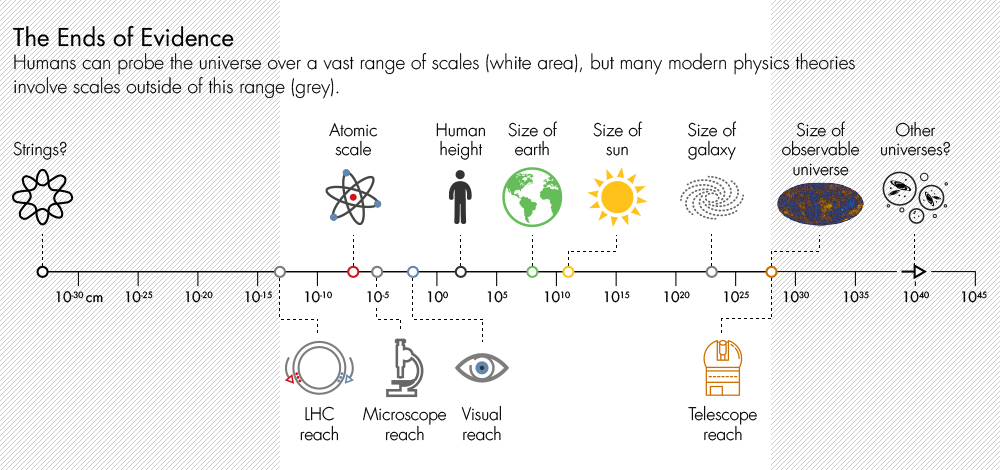
    The dogged pursuit of a fundamental theory governing all forces of nature requires physicists to inspect the universe more and more closely — to examine, for instance, the atoms within matter, the protons and neutrons within those atoms, and the quarks within those protons and neutrons. But this zooming in demands evermore energy, and the difficulty and cost of building new machines increases exponentially relative to the energy requirement, Gross said. “It hasn’t been a problem so much for the last 400 years, where we’ve gone from centimeters to millionths of a millionth of a millionth of a centimeter” — the current resolving power of the Large Hadron Collider (LHC) in Switzerland, he said. “We’ve gone very far, but this energy-squared is killing us.”

    As we approach the practical limits of our ability to probe nature’s underlying principles, the minds of theorists have wandered far beyond the tiniest observable distances and highest possible energies. Strong clues indicate that the truly fundamental constituents of the universe lie at a distance scale 10 million billion times smaller than the resolving power of the LHC. This is the domain of nature that string theory, a candidate “theory of everything,” attempts to describe. But it’s a domain that no one has the faintest idea how to access.

    The problem also hampers physicists’ quest to understand the universe on a cosmic scale: No telescope will ever manage to peer past our universe’s cosmic horizon and glimpse the other universes posited by the multiverse hypothesis. Yet modern theories of cosmology lead logically to the possibility that our universe is just one of many.

    Tynan DeBold for Quanta Magazine; Icons via Freepik


    Whether the fault lies with theorists for getting carried away, or with nature, for burying its best secrets, the conclusion is the same: Theory has detached itself from experiment. The objects of theoretical speculation are now too far away, too small, too energetic or too far in the past to reach or rule out with our earthly instruments. So, what is to be done? As Ellis and Silk wrote, “Physicists, philosophers and other scientists should hammer out a new narrative for the scientific method that can deal with the scope of modern physics.”

    “The issue in confronting the next step,” said Gross, “is not one of ideology but strategy: What is the most useful way of doing science?”

    Over three mild winter days, scholars grappled with the meaning of theory, confirmation and truth; how science works; and whether, in this day and age, philosophy should guide research in physics or the other way around. Over the course of these pressing yet timeless discussions, a degree of consensus took shape.

    Rules of the Game

    Throughout history, the rules of science have been written on the fly, only to be revised to fit evolving circumstances. The ancients believed they could reason their way toward scientific truth. Then, in the 17th century, Isaac Newton ignited modern science by breaking with this “rationalist” philosophy, adopting instead the “empiricist” view that scientific knowledge derives only from empirical observation. In other words, a theory must be proved experimentally to enter the book of knowledge.

    But what requirements must an untested theory meet to be considered scientific? Theorists guide the scientific enterprise by dreaming up the ideas to be put to the test and then interpreting the experimental results; what keeps theorists within the bounds of science?

    Today, most physicists judge the soundness of a theory by using the Austrian-British philosopher Karl Popper’s rule of thumb. In the 1930s, Popper drew a line between science and nonscience in comparing the work of Albert Einstein with that of Sigmund Freud. Einstein’s theory of general relativity, which cast the force of gravity as curves in space and time, made risky predictions — ones that, if they hadn’t succeeded so brilliantly, would have failed miserably, falsifying the theory. But Freudian psychoanalysis was slippery: Any fault of your mother’s could be worked into your diagnosis. The theory wasn’t falsifiable, and so, Popper decided, it wasn’t science.

    Paul Teller (by window), a philosopher and professor emeritus at the University of California, Davis.

    Laetitia Vancon for Quanta Magazine


    Critics accuse string theory and the multiverse hypothesis, as well as cosmic inflation — the leading theory of how the universe began — of falling on the wrong side of Popper’s line of demarcation. To borrow the title of the Columbia University physicist Peter Woit’s 2006 book on string theory, these ideas are “not even wrong,” say critics. In their editorial, Ellis and Silk invoked the spirit of Popper: “A theory must be falsifiable to be scientific.”

    But, as many in Munich were surprised to learn, falsificationism is no longer the reigning philosophy of science. Massimo Pigliucci, a philosopher at the Graduate Center of the City University of New York, pointed out that falsifiability is woefully inadequate as a separator of science and nonscience, as Popper himself recognized. Astrology, for instance, is falsifiable — indeed, it has been falsified ad nauseam — and yet it isn’t science. Physicists’ preoccupation with Popper “is really something that needs to stop,” Pigliucci said. “We need to talk about current philosophy of science. We don’t talk about something that was current 50 years ago.”

    Nowadays, as several philosophers at the workshop said, Popperian falsificationism has been supplanted by Bayesian confirmation theory, or Bayesianism, a modern framework based on the 18th-century probability theory of the English statistician and minister Thomas Bayes. Bayesianism allows for the fact that modern scientific theories typically make claims far beyond what can be directly observed — no one has ever seen an atom — and so today’s theories often resist a falsified-unfalsified dichotomy. Instead, trust in a theory often falls somewhere along a continuum, sliding up or down between 0 and 100 percent as new information becomes available. “The Bayesian framework is much more flexible” than Popper’s theory, said Stephan Hartmann, a Bayesian philosopher at LMU. “It also connects nicely to the psychology of reasoning.”

    Gross concurred, saying that, upon learning about Bayesian confirmation theory from Dawid’s book, he felt “somewhat like the Molière character who said, ‘Oh my God, I’ve been talking prose all my life!’”

    Another advantage of Bayesianism, Hartmann said, is that it is enabling philosophers like Dawid to figure out “how this non-empirical evidence fits in, or can be fit in.”

    Another Kind of Evidence

    Dawid, who is 49, mild-mannered and smiley with floppy brown hair, started his career as a theoretical physicist. In the late 1990s, during a stint at the University of California, Berkeley, a hub of string-theory research, Dawid became fascinated by how confident many string theorists seemed to be that they were on the right track, despite string theory’s complete lack of empirical support. “Why do they trust the theory?” he recalls wondering. “Do they have different ways of thinking about it than the canonical understanding?”

    String theory says that elementary particles have dimensionality when viewed close-up, appearing as wiggling loops (or “strings”) and membranes at nature’s highest zoom level. According to the theory, extra dimensions also materialize in the fabric of space itself. The different vibrational modes of the strings in this higher-dimensional space give rise to the spectrum of particles that make up the observable world. In particular, one of the vibrational modes fits the profile of the “graviton” — the hypothetical particle associated with the force of gravity. Thus, string theory unifies gravity, now described by Einstein’s theory of general relativity, with the rest of particle physics.

    Video: Richard Dawid, a physicist-turned-philosopher at Ludwig Maximilian University in Munich.

    Laetitia Vancon for Quanta Magazine

    However string theory, which has its roots in ideas developed in the late 1960s, has made no testable predictions about the observable universe. To understand why so many researchers trust it anyway, Dawid signed up for some classes in philosophy of science, and upon discovering how little study had been devoted to the phenomenon, he switched fields.

    In the early 2000s, he identified three non-empirical arguments that generate trust in string theory among its proponents. First, there appears to be only one version of string theory capable of achieving unification in a consistent way (though it has many different mathematical representations); furthermore, no other “theory of everything” capable of unifying all the fundamental forces has been found, despite immense effort. (A rival approach called loop quantum gravity describes gravity at the quantum scale, but makes no attempt to unify it with the other forces.) This “no-alternatives” argument, colloquially known as “string theory is the only game in town,” boosts theorists’ confidence that few or no other possible unifications of the four fundamental forces exist, making it more likely that string theory is the right approach.

    Second, string theory grew out of the Standard Model — the accepted, empirically validated theory incorporating all known fundamental particles and forces (apart from gravity) in a single mathematical structure — and the Standard Model also had no alternatives during its formative years. This “meta-inductive” argument, as Dawid calls it, buttresses the no-alternatives argument by showing that it has worked before in similar contexts, countering the possibility that physicists simply aren’t clever enough to find the alternatives that exist.

    Emily Fuhrman for Quanta Magazine, with text by Natalie Wolchover and art direction by Olena Shmahalo.

    The third non-empirical argument is that string theory has unexpectedly delivered explanations for several other theoretical problems aside from the unification problem it was intended to address. The staunch string theorist Joe Polchinski of the University of California, Santa Barbara, presented several examples of these “unexpected explanatory interconnections,” as Dawid has termed them, in a paper read in Munich in his absence. String theory explains the entropy of black holes, for example, and, in a surprising discovery that has caused a surge of research in the past 15 years, is mathematically translatable into a theory of particles, such as the theory describing the nuclei of atoms.

    Polchinski concludes that, considering how far away we are from the exceptionally fine grain of nature’s fundamental distance scale, we should count ourselves lucky: “String theory exists, and we have found it.” (Polchinski also used Dawid’s non-empirical arguments to calculate the Bayesian odds that the multiverse exists as 94 percent — a value that has been ridiculed by the Internet’s vocal multiverse critics.)

    One concern with including non-empirical arguments in Bayesian confirmation theory, Dawid acknowledged in his talk, is “that it opens the floodgates to abandoning all scientific principles.” One can come up with all kinds of non-empirical virtues when arguing in favor of a pet idea. “Clearly the risk is there, and clearly one has to be careful about this kind of reasoning,” Dawid said. “But acknowledging that non-empirical confirmation is part of science, and has been part of science for quite some time, provides a better basis for having that discussion than pretending that it wasn’t there, and only implicitly using it, and then saying I haven’t done it. Once it’s out in the open, one can discuss the pros and cons of those arguments within a specific context.”

    The Munich Debate

    Laetitia Vancon for Quanta Magazine


    The trash heap of history is littered with beautiful theories. The Danish historian of cosmology Helge Kragh, who detailed a number of these failures in his 2011 book, Higher Speculations, spoke in Munich about the 19th-century vortex theory of atoms. This “Victorian theory of everything,” developed by the Scots Peter Tait and Lord Kelvin, postulated that atoms are microscopic vortexes in the ether, the fluid medium that was believed at the time to fill space. Hydrogen, oxygen and all other atoms were, deep down, just different types of vortical knots. At first, the theory “seemed to be highly promising,” Kragh said. “People were fascinated by the richness of the mathematics, which could keep mathematicians busy for centuries, as was said at the time.” Alas, atoms are not vortexes, the ether does not exist, and theoretical beauty is not always truth.

    Except sometimes it is. Rationalism guided Einstein toward his theory of relativity, which he believed in wholeheartedly on rational grounds before it was ever tested. “I hold it true that pure thought can grasp reality, as the ancients dreamed,” Einstein said in 1933, years after his theory had been confirmed by observations of starlight bending around the sun.

    The question for the philosophers is: Without experiments, is there any way to distinguish between the non-empirical virtues of vortex theory and those of Einstein’s theory? Can we ever really trust a theory on non-empirical grounds?

    In discussions on the third afternoon of the workshop, the LMU philosopher Radin Dardashti asserted that Dawid’s philosophy specifically aims to pinpoint which non-empirical arguments should carry weight, allowing scientists to “make an assessment that is not based on simplicity, which is not based on beauty.” Dawidian assessment is meant to be more objective than these measures, Dardashti explained — and more revealing of a theory’s true promise.

    Gross said Dawid has “described beautifully” the strategies physicists use “to gain confidence in a speculation, a new idea, a new theory.”

    “You mean confidence that it’s true?” asked Peter Achinstein, an 80-year-old philosopher and historian of science at Johns Hopkins University. “Confidence that it’s useful? confidence that …”

    “Let’s give an operational definition of confidence: I will continue to work on it,” Gross said.

    “That’s pretty low,” Achinstein said.

    “Not for science,” Gross said. “That’s the question that matters.”

    Kragh pointed out that even Popper saw value in the kind of thinking that motivates string theorists today. Popper called speculation that did not yield testable predictions “metaphysics,” but he considered such activity worthwhile, since it might become testable in the future. This was true of atomic theory, which many 19th-century physicists feared would never be empirically confirmed. “Popper was not a naive Popperian,” Kragh said. “If a theory is not falsifiable,” Kragh said, channeling Popper, “it should not be given up. We have to wait.”

    But several workshop participants raised qualms about Bayesian confirmation theory, and about Dawid’s non-empirical arguments in particular.

    Carlo Rovelli, a proponent of loop quantum gravity (string theory’s rival) who is based at Aix-Marseille University in France, objected that Bayesian confirmation theory does not allow for an important distinction that exists in science between theories that scientists are certain about and those that are still being tested. The Bayesian “confirmation” that atoms exist is essentially 100 percent, as a result of countless experiments. But Rovelli says that the degree of confirmation of atomic theory shouldn’t even be measured in the same units as that of string theory. String theory is not, say, 10 percent as confirmed as atomic theory; the two have different statuses entirely. “The problem with Dawid’s ‘non-empirical confirmation’ is that it muddles the point,” Rovelli said. “And of course some string theorists are happy of muddling it this way, because they can then say that string theory is ‘confirmed,’ equivocating.”

    The German physicist Sabine Hossenfelder, in her talk, argued that progress in fundamental physics very often comes from abandoning cherished prejudices (such as, perhaps, the assumption that the forces of nature must be unified). Echoing this point, Rovelli said “Dawid’s idea of non-empirical confirmation [forms] an obstacle to this possibility of progress, because it bases our credence on our own previous credences.” It “takes away one of the tools — maybe the soul itself — of scientific thinking,” he continued, “which is ‘do not trust your own thinking.’”

    The Munich proceedings will be compiled and published, probably as a book, in 2017. As for what was accomplished, one important outcome, according to Ellis, was an acknowledgment by participating string theorists that the theory is not “confirmed” in the sense of being verified. “David Gross made his position clear: Dawid’s criteria are good for justifying working on the theory, not for saying the theory is validated in a non-empirical way,” Ellis wrote in an email. “That seems to me a good position — and explicitly stating that is progress.”

    In considering how theorists should proceed, many attendees expressed the view that work on string theory and other as-yet-untestable ideas should continue. “Keep speculating,” Achinstein wrote in an email after the workshop, but “give your motivation for speculating, give your explanations, but admit that they are only possible explanations.”

    “Maybe someday things will change,” Achinstein added, “and the speculations will become testable; and maybe not, maybe never.” We may never know for sure the way the universe works at all distances and all times, “but perhaps you can narrow the live possibilities to just a few,” he said. “I think that would be some progress.”

    Reprinted from The Atlantic