Showing posts with label MLOps. Show all posts

Context Engineering for Coding Agents - Fausto's Amsterdam workshop

Mike's Notes

The MLOps Community is fantastic, and it has a regular newsletter from Demetrios.

100% better than anything coming out of NZ  or Australia. I attend MLOps events remotely whenever possible. Now I know where to find the talent capable of working on Pipi in future.

This is taken from a recent newsletter. Interesting how deterministic and probabilistic contexts are handled in generative AI.

All Pipi Engines are both deterministic and probabilistic as required.

The April 21 2026, MLOps Community Netherlands workshop video and slides are available.

Resources

References

  • Reference

Repository

  • Home > Ajabbi Research > Library > Subscriptions > MLOps Community
  • Home > Handbook > 

Last Updated

10/05/2026

Context Engineering for Coding Agents - Fausto's Amsterdam workshop

By: Demetrios Brinkmann
MLOps Community: 07/05/2026

Demetrios founded the largest community dealing with productizing AI and ML models. In April 2020, he fell into leading the MLOps community (more than 75k ML practitioners come together to learn and share experiences), which aims to bring clarity around the operational side of Machine Learning and AI. Since diving into the ML/AI world, he has become fascinated by Voice AI agents and is exploring the technical challenges that come with creating them.

Fausto's workshop focused on the part of agent systems you can control: what gets injected into the context window, when it gets loaded, and what should live somewhere else. You are not training the model on a daily basis, so the engineering work shifts to managing context, memory, tools, and retrieval.

His rule of thumb was to keep context usage under 25%, regardless of whether you are working with a 200k or 1M token model. Past that, things get slower, more expensive, and more error-prone, with cleaner options than letting the context window bloat.

The lens for the rest of the talk was a brain analogy. Attention is finite, memory shapes attention, and knowledge does not get embedded in a vacuum. An agent will only notice the right things if you have given it the right priors.

From there, Fausto split context into three categories.

  • Deterministic context includes CLAUDE.md, project rules, hooks on lifecycle events, auto-memory, and scheduled loops. His point on rules was especially practical: coding conventions belong in path-scoped or file-extension-scoped rules, not dumped into CLAUDE.md.
  • Human context covers chat turns, slash commands, and references.
  • Probabilistic context covers sub-agents, retrieval, MCPs, skills, and observers. Sub-agents are useful because they do not inherit CLAUDE.md, memory, or the default system prompt, which makes them better suited for specific non-coding tasks. Skills are markdown plus optional scripts, and can also wrap calls to other models when Claude cannot handle the job. Fausto's example was routing native video analysis through Gemini.

Two practical tips came out of this section. Turn on deferred tool loading, a single flag that reduces what gets injected at session start. And lean toward project scope over user scope for skills and MCPs, so the agent has the full descriptions it needs to choose well at runtime.

The second half made the case for treating long-term memory as a folder of markdown files rather than defaulting to a vector store, inspired by Karpathy's wiki memory idea.

The structure is an index plus raw source files, processed summaries, and a policy that decides what to ingest and retrieve. Concepts that recur get weighted up. Concepts that go unused decay over time. An observer agent watches the session and either pulls relevant knowledge into the active context or pushes new findings into the wiki.

To show the difference in practice, Fausto ran two Claude Code sessions on the same cellular automata task. Same model, same skills, same sub-agents, same CLAUDE.md. The only difference was that one had a populated wiki and the other did not. Under a five-minute timer, the wiki run pulled the concepts it needed and produced a working visualization. The default run fell back on parametric memory and live search, then ran out of time.


Context Engineering for Coding Agents: Hands-on Lab + Agent Build-Off

21 April 2026
Prosus NV
Gustav Mahlerplein 5, 1082 MS Amsterdam, Netherlands

A hands-on workshop on configuring Claude Code for real work.
​Claude Code is powerful out of the box. But there's a gap between using it and mastering it. Closing that gap is mostly a matter of context: what the agent knows, where its memory lives, which rules it follows, and how its output gets verified before it ships.

​This workshop is three hours of hands-on practice to optimize your Claude environment. After a short primer you join a pre-assigned team and build out a Claude Code setup in a prepared sandbox — working on memory, rules, hooks, retrieval, and prompt quality. In the final stretch we drop an unknown technical drawing on the screen and your system gets one run at it. Scores go on a live leaderboard, winners are announced in the room.

​What you'll practice

  • ​Shaping what the agent sees and remembers
  • ​Writing rules and hooks that actually fire
  • ​Designing memory so it finds what matters
  • ​Judging output before it leaves the loop

Format

​One continuous team build, one unknown challenge, one live leaderboard, closing with pizza and drinks. — The system you build in 60 minutes is the score you receive.

​Agenda

  • ​5:00 PM — Walking dinner & Drinks
  • ​please be on time :)
  • ​5:30 – 5:45 PM — Welcome by Prosus
  • ​Opening and framing for the evening.
  • ​5:45 – 6:00 PM — Opening
  • ​6:00 – 7:00 PM — Theory + Mini-Demos
  • ​7:00 – 8:00 PM — Build Lab
​Six phases: mission lock, sandbox orientation, second brain, skills + guardrails, self-test, freeze. Teams build their Claude Code system against the run contract. Facilitators float; the deck runs a silent timer.
  • ​8:00 – 8:15 PM — Drawing Reveal + One-Shot Run
  • ​An unknown technical drawing is broadcast into every team sandbox. Each system gets a single run. Whatever it produces is what gets scored.
  • ​8:15 – 8:20 PM — Processing Break
  • ​Last runs finish, evaluator collects output.
  • ​8:20 – 8:30 PM — Live Leaderboard + Winners
  • ​Scores land on screen. Jury walks through the top runs and the most interesting architectural choices.
  • ​8:30 – 9:00 PM — Pizza + Networking
  • ​Pizza, drinks, Q&A.

​Who this is for

​Technical practitioners who have already used Claude Code (or a comparable coding agent) and want to push past the default setup. Comfortable on the command line, and with Github, fluent enough in Python to read and edit a small repo.

​What we provide

  • ​A pre-configured cloud sandbox per team, with Claude Code installed and API access included. Minimum requirement is to have a Claude Pro account — and bring your laptop.
  • ​Registering is not a confirmed seat — we curate the room and send confirmations separately
​Delivered by Fausto Albers · GenAI R&D, AUAS · WonderWhy.ai

YouTube 2:27:28

Chips Huyen MLOps guide

Mike's Notes

I was mesmerised by Chips's talks, which explained MLOps very clearly. Here is a copy of her resources page. The original page has many links. A fantastic resource.

"MLOps (Machine Learning Operations) is a set of practices combining Machine Learning, DevOps, and Data Engineering to automate, standardize, and manage the end-to-end lifecycle of ML models. It aims to increase automation (CI/CD) for faster, reliable deployment, while maintaining model performance and monitoring for drift." - Databricks

Resources

References

  • Reference

Repository

  • Home > Ajabbi Research > Library >
  • Home > Handbook > 

Last Updated

30/03/2026

Chips Huyen MLOPs guide

By: Chips Huyen
Chip Huyen: 11/01/2025

I’m Chip Huyen, a writer and computer scientist. I grew up chasing grasshoppers in a small rice-farming village in Vietnam.

My focus is on ML/AI systems in production. I’m currently exploring creative use cases of AI in education and entertainment.

Previously, I worked on ML tooling at NVIDIA (core dev of NeMo), Snorkel AI, and Netflix. I also founded and sold an AI infra startup.

Running a startup taught me that being a founder is incredibly hard, so I try to support founders in any way I can. Some startups I’ve worked with included Convai, OctoAI, and Photoroom.

I graduated from Stanford, where I taught ML Systems. The lectures became the foundation for the book Designing Machine Learning Systems, which is an Amazon #1 bestseller in AI and has been translated into 10+ languages (very proud)!

My new book AI Engineering (2025) is currently the most read book on the O’Reilly platform. It’s also available on Amazon and Kindle.

I’m active on GitHub and aspire to become a Goodreads influencer. You can also find me on Google Scholar. I frequently speak at and occasionally host events.

I enjoy learning about fun technical challenges and collaborating with great teams. Reach out if you want to find a way to work together!.

Update (Jan 11, 2025): I’m working on a minimum viable curriculum for ML/AI engineering. Here’s the interest form if you want to test out the curriculum.

A collection of materials from introductory to advanced. This is roughly the path I’d follow if I were to start my MLOps journey again.

Table of contents

  • ML + engineering fundamentals
  • MLOps
  • …. Overview
  • …. Intermediate
  • …. Advanced
  • Career
  • Case studies
  • Bonus

ML + engineering fundamentals

While it’s tempting to want to get straight to ChatGPT, it’s important to have a good grasp of machine learning, deep learning, NLP, and reinforcement learning fundamentals.

  • 10 free ML courses: make sure to take those classes in order.
  • [Book] Machine Learning: A Probabilistic Perspective (Kevin P. Murphy). A draft PDF link can be found here.
  • [Book] Information Theory, Inference, and Learning Algorithms (David MacKay). Free online version here.
  • [Book] Deep Learning (Ian Goodfellow, Yoshua Bengio, and Aaron Courville). Free online version.
  • [Book] Introduction to Information Retrieval (Christopher D. Manning, Prabhakar Raghavan, and Hinrich Schütze). Essential for anyone interested in Natural Language Processing. Free online version.
  • [Book] Reinforcement Learning: An Introduction (Richard S. Sutton and Andrew G. Barto). Essential for reinforcement learning. Free online version.
  • [Tutorials] OpenAI’s Spinning up in Deep Reinforcement Learning: A collection of articles that give great intuition for many RL algorithms. Highly recommended for anyone interested in RL.
  • [Video] Andrej Karpathy’s Zero to Hero series
  • Tools and concepts I’d prioritize learning
  • A survivor’s guide to AI courses at Stanford (Updated Feb 2020)

MLOps

What’s MLOps?

Ops in MLOps comes from DevOps, short for Developments and Operations. To operationalize something means to bring it into production, which includes deploying, monitoring, and maintaining it.

Currently, this section contains a lot of my writing, certainly because of my bias and because when I set out to learn about MLOps, there wasn’t a lot of resources about it yet. I’ll add more materials soon!

  • [Book] Designing Machine Learning Systems (O’Reilly, 2022)
  • [Community] Some of the best discussions I have had are on our MLOps Discord server [15k+ members]. You’re welcome to ask questions and join us in our monthly talks/discussions!

Overview

Overview of ML in production.

  • [Video] Machine learning production myths (Stanford’s MLSys Seminars)
  • [Lecture note] Introduction to machine learning in production
  • Rules of Machine Learning: Best Practices for ML Engineering (Martin Zinkevich, 2019)
  • What I learned from looking at 200 machine learning tools [Jun 2020]
  • Machine Learning Tools Landscape v2 (+84 new tools) [Dec 2020]
  • The ML Test Score: A Rubric for ML Production Readiness and Technical Debt Reduction (Breck et al., 2017)
  • Building LLM applications for production

Intermediate

Deep dives into different aspects of ML production.

  • [Lecture note] Creating training data: sampling, labeling, handling class imbalance, data augmentation
  • [Lecture note] Feature engineering
  • [Book excerpt] Data Distribution Shifts and Monitoring
  • Instrumentation, Observability & Monitoring of Machine Learning Models (Josh Wills, 2019)
  • RLHF: Reinforcement Learning from Human Feedback

Advanced

Build the best MLOps platform for your organization!

  • Real-time machine learning: challenges and solutions
  • [Lecture note] Data system fundamentals for data scientists
  • A friendly introduction to machine learning compilers and optimizers
  • Why data scientists shouldn’t need to know Kubernetes
  • Self-serve feature platforms: architectures and APIs

Career

  • [Free book] Machine Learning Interviews Book
  • [Twitter thread] The ML interviews process
  • Career advice for recent Computer Science graduates
  • Four lessons I learned after my first full-time job after college
  • 7 reasons not to join a startup and 1 reason to
  • Analysis of compensation, level, and experience details of 19k tech workers
  • What Glassdoor interview reviews reveal about tech hiring cultures
  • What we look for in a resume

Case studies

To get a sense of the challenges of machine learning production, it’s helpful to learn from companies who are doing it.

  1. Using Machine Learning to Predict Value of Homes On Airbnb (Robert Chang, Airbnb Engineering & Data Science, 2017)

    In this detailed and well-written blog post, Chang described how Airbnb used machine learning to predict an important business metric: the value of homes on Airbnb. It walks you through the entire workflow: feature engineering, model selection, prototyping, moving prototypes to production. It’s completed with lessons learned, tools used, and code snippets too.

  2. Using Machine Learning to Improve Streaming Quality at Netflix (Chaitanya Ekanadham, Netflix Technology Blog, 2018)

    As of 2018, Netflix streams to over 117M members worldwide, half of those living outside the US. This blog post describes some of their technical challenges and how they use machine learning to overcome these challenges, including to predict the network quality, detect device anomaly, and allocate resources for predictive caching.
    To understand Netflix’s infrastructure for machine learning, check out Ville Tuulos’s talk Human-Centric Machine Learning Infrastructure @Netflix.

  3. 150 Successful Machine Learning Models: 6 Lessons Learned at Booking.com (Bernardi et al., KDD, 2019)

    As of 2019, Booking.com has around 150 machine learning models in production. These models solve a wide range of prediction problems (e.g. predicting users’ travel preferences and how many people they travel with) and optimization problems (e.g.optimizing the background images and reviews to show for each user). Adrian Colyer gave a good summary of the six lessons learned here:
    • Machine learned models deliver strong business value.
    • Model performance is not the same as business performance.
    • Be clear about the problem you’re trying to solve.
    • Prediction serving latency matters.
    • Get early feedback on model quality.
    • Test the business impact of your models using randomized controlled trials.

  4. Machine Learning-Powered Search Ranking of Airbnb Experiences (Mihajlo Grbovic, Airbnb Engineering & Data Science, 2019)

    This article walks you step by step through a canonical example of the ranking and recommendation problem. The four main steps are system design, personalization, online scoring, and business aspect. The article explains which features to use, how to collect data and label it, why they chose Gradient Boosted Decision Tree, which testing metrics to use, what heuristics to take into account while ranking results, how to do A/B testing during deployment. Another wonderful thing about this post is that it also covers personalization to rank results differently for different users.

  5. From shallow to deep learning in fraud (Hao Yi Ong, Lyft Engineering, 2018)

    Fraud detection is one of the earliest use cases of machine learning in the industry. This article explores the evolution of fraud detection algorithms used at Lyft. At first, an algorithm as simple as logistic regression with engineered features was enough to catch most fraud cases. Its simplicity allowed the team to understand the importance of different features. Later, when fraud techniques have become too sophisticated, more complex models are required. This article explores the tradeoff between complexity and interpretability, performance and ease of deployment.

  6. Space, Time and Groceries (Jeremy Stanley, Tech at Instacart, 2017)

    Instacart uses machine learning to solve the task of path optimization: how to most efficiently assign tasks for multiple shoppers and find the optimal paths for them. The article explains the entire process of system design, from framing the problem, collecting data, algorithm and metric selection, topped with a tutorial for beautiful visualization.

  7. Creating a Modern OCR Pipeline Using Computer Vision and Deep Learning (Brad Neuberg, Dropbox Engineering, 2017)

    An application as simple as a document scanner has two distinct components: optical character recognition and word detector. Each requires its own production pipeline, and the end-to-end system requires additional steps for training and tuning. This article also goes into detail the team’s effort to collect data, which includes building their own data annotation platform.

  8. Scaling Machine Learning at Uber with Michelangelo (Jeremy Hermann and Mike Del Balso, Uber Engineering, 2019)

    Uber uses extensive machine learning in their production, and this article gives an impressive overview of their end-to-end workflow, where machine learning is being applied at Uber, and how their teams are organized.

  9. How we grew from 0 to 4 million women on our fashion app, with a vertical machine learning approach (Gabriel Aldamiz, HackerNoon, 2018)

    To offer automated outfit advice, Chicisimo tried to qualify people’s fashion taste using machine learning. Due to the ambiguous nature of the task, the biggest challenges are framing the problem and collecting the data for it, both challenges are addressed by the article. It also covers the problem that every consumer app struggles with: user retention.

Bonus

Some stuff I did that don’t quite fit into any section above, but I want to share anyway :P

  • [Code] Python-is-cool: Cool Python features that I used to be too afraid to use
  • [Code] just-pandas-things: Pandas quirks that used to traumatize me
  • [Code] Coding exercises and solutions for coding interviews
  • [Video] Switching From a Batch to Streaming Mindset w/ Chip Huyen
  • [VentureBeat] 4 AI and ML job hunting tips from Chip Huyen
  • [Booklet] Machine learning systems design (2019): My initial notes on ML systems back. This 8000-word booklet gave ideas for the book Designing Machine Learning Systems in 2022.

Developer access to Pipi, is coming

Mike's Notes

The data is precise on this one. Unfortunately, the current developer interest in NZ and Australia is 3% and 0%, respectively. I also can't find anyone in NZ who has the slightest technical understanding of what I'm doing. But there are plenty overseas, especially in MLOps. We speak the same language, even if the architecture and algorithms are radically different. Also, top-grade mathematicians get it. Internally, Pipi 9 uses a lot of maths.

Resources

References

  • Reference

Repository

  • Home > Ajabbi Research > Library >
  • Home > Handbook > 

Last Updated

08/12/2025

Developer access to Pipi is coming

By: Mike Peters
On a Sandy Beach: 02/12/2025

Mike is the inventor and architect of Pipi and the founder of Ajabbi.

The problem

To launch Pipi 9 with limited resources in 2026, the effort needs to be highly focused on developers who build large enterprise systems and have experienced failure, cost overruns, and staggering complexity. This is for them.

Waste

The staggering annual global cost of IT failures on big projects is around $US 3 trillion. How many schools or knee replacements would that be?

  • 15% succeed
  • 25% makes no difference
  • 60% fail

Web traffic stats

The steadily growing web traffic statistics of public interest in Pipi 9 are becoming very clear.

Since early 2019, the total traffic stats by country are;

  • China 19%
  • Singapore 16%
  • United States 15%
  • Hong Kong 11%
  • Brazil 10%
  • TOTAL 71%

Developer Accounts

The initial paid Developer Accounts will be restricted to experienced DevOps teams with great internal culture in those five countries. That also affects the language, currency, hours of support availability, etc. Later, as interest and resources grow, that list of countries can be expanded.

Personal Accounts

The free Personal Accounts will initially use an English interface and will not be restricted by country of residence. They will get community support.

Enterprise Accounts

The initial paid Enterprise Accounts will be supported by their associated Developer Accounts, who can charge them whatever they want for that service. They will initially use an English interface and will not be restricted by country of residence. Developer Accounts will be able to translate UI and documentation into any language and writing system.

Pipi 9 is in hiding

This engineering blog and the many other Ajabbi documentation websites are deliberately hidden from search engines. People are visiting because they are curious, as I write notes to myself and build, learning as I go. It is not easy to find the technical documentation unless you are really interested, clever and very determined. That has helped me find some early, keen technical fans who provide testing and feedback. It has also protected me from being overwhelmed by enquiries.

Communication constraints

I am a very slow writer, using assistive technology, have hearing problems and prefer video chats with people who speak good, clear English. I don't speak any other language apart from tiny bits of Maori, French and Spanish.

SEO and GEO

The SEO/GEO settings will be fixed when

  • Pipi 9 matures and becomes ready for public use
  • Community support is in place
  • Bugs fixed
  • Enough self-help documentation to help people get started.

Developer Account waitlist

There will be a signup queue to control demand, so scaling is steady with a positive resource feedback loop to solve the chicken-and-egg problem. The small queue is growing now. I will pick the best candidates with the highest chance of success. They will gain a first-mover advantage in building large, custom enterprise systems faster and at a much lower cost. The first ones will get free unlimited support. 

Relying on word-of-mouth recommendations.

There will be no marketing or sales, just good, clear documentation, live demos, and regular bookable office hours (NZ daytime) for having a chat.

Inflexion point

In the future, as workspaces mature and Pipi 10 becomes even easier to work with, resource constraints will disappear, teams will grow, and an inflexion point will be reached. Anyone will then be able to sign up.

Agents in Production on replay

Mike's Notes

The videos of the talks given at the recent Agents in Production are now available to watch. The talks are technically excellent. I watched some of it (It started at 3 am NZ Time), so I will watch the rest from now.

Resources

References

  • Reference

Repository

  • Home > Ajabbi Research > Library > Subscriptions > MLOps Community
  • Home > Handbook > 

Last Updated

24/11/2025

Agents in Production on replay

By: 
MLOps Community: 24/11/2025

The Virtual AI Event That’s Actually... Fun

We know what you’re thinking: another virtual conference. Talking heads, awkward silences, and the constant urge to check your email… we’ve all been there.

Not this one.

100% AI Agents in Prod. BUT This Isn't Just Another Zoom Link.

Welcome to Agents in Production: the latest edition of the MLOps × Prosus AI Virtual Conference.

We’re bringing together the brightest minds building AI agents, with a high-energy format designed to keep you hooked from start to finish.

Last year, companies stopped experimenting with agents and started deploying them in the real world. We heard from the pioneers who turned hype into working systems - and this year, we’re doubling down.

Expect real progress, real lessons, and real breakthroughs shaping the future of agentic AI. You’ll get cutting-edge, actionable insights that move you from experimentation to full-scale deployment.

30+ Talks on AI Agents. I Promise You Won’t Log Off Early

Why Attend:

  • Talks from top experts – Real-world lessons, practical insights, and breakthroughs defining agentic AI.
  • Hilarious skits & live music – Because learning should be fun.
  • High-energy engagement – Interactive moments that make you part of the action.

If You Miss This, You’ll Miss:

  • Hard-won lessons – How leading companies are successfully deploying agents at scale.
  • Deep dives – Technical sessions and workshops from the voices shaping the next generation of AI.
  • Global connections – Network with innovators and practitioners across the ML community.
  • This is your chance to get up to speed on the global AI scene, connect with innovators, and experience a virtual event you’ll actually enjoy.

See you there! 

Speakers

  • Chip Huyen, Researcher @ Tep Studio
  • Aditya Gautam, Machine Learning Technical Lead @ Meta
  • Teodora Musatoiu, Solutions Architect @ OpenAI
  • Adel El Hallak, Senior Director Of Product @ NVIDIA
  • Panos Stravopodis, Co-Founder & CTO @ Elyos
  • Jiquan Ngiam, CEO and Co-Founder @ MintMCP
  • Chenyu Zhang, Founder @ GlowingStar Inc.
  • Rekha Singhal, Head Research @ Tata Consultancy Services
  • Santoshkalyan Rayadhurgam, Engineering Leader @ Meta
  • Swati Bhatia, Product Manager @ Google
  • Arushi Jain, Senior Applied Scientist @ Microsoft
  • Donné Stevenson, Machine Learning Engineer @ Prosus Group
  • Mefta Sadat, Staff Software Engineer @ Loblaw Digital
  • Sam Partee, Co-Founder @ Arcade.dev
  • Sachi Shah, Product Manager @ Sierra
  • Jasleen Singh, Staff Solutions Architect, Generative AI @ Google
  • Sanjana Sharma, AI Strategist @ Distyl AI
  • Artem Yushkovskiy, Sr ML Engineer @ Delivery Hero SE
  • Rosemary Nwosu-Ihueze, Founder @ Soteria
  • Euro Beinat, Global Head AI and Data Science @ Prosus Group
  • Washington Amolo, Product Developer @ NaviSmart AI
  • Benjamin Guo, Co Founder @ Zo Computer
  • Hamed Taheri, CEO & Founder @ Personize.ai
  • Phil Stafford, Principal Consultant, Cybersecurity & AI @ Singularity Systems
  • Quinten Rosseel, AI Engineer @ Wobby
  • Dirk Petzoldt, Co-Founder @ Explai.com
  • Tom Kaltofen, Engineer @ mloda
  • Rachitt Shah, Applied AI consultant @ Transfrm Labs
  • Vitor Balocco, Co-founder @ Runlayer
  • Frank Wittkampf, VP Applied AI @ Databook
  • Laurel Orr, AI Staff Software Engineer @ Stacklok
  • Benjamin Hindman, Founder & CEO @ Reboot
  • Ben Epstein, Co-Founder & CTO @ GrottoAI
  • Matt Sharp, AI Strategist and Principle Engineer @ Flexion
  • Audi Liu, Senior Product Manager @ Inworld AI
  • Olga Pavlov, Head of Product @ OLX Group
  • Isabella Piratininga, Director of Technology & Innovation @ iFood
  • Paul van der Boor, Senior Director Data Science @ Prosus Group
  • Demetrios Brinkmann, Chief Happiness Engineer @ MLOps Community
  • Ricky Doar, VP of Solutions @ Cursor
  • Nishikant Dhanuka, Senior Director of AI @ Prosus Group
  • Chiara Caratelli, Data Scientist @ Prosus Group
  • Simba Khadder, Sr. Manager & Software Engineer @ Redis

Types of AI agents

Mike's Notes

I only built one type of AI agent. I didn't realise there were other types. Again, learned from the MLOPs community.

By the way, I like how IBM organise their website information. Very clean and tidy, and no crap in their HTML when I copied it to this post. Very impressive and unusual.

Resources

References

  • Reference

Repository

  • Home > Ajabbi Research > Library >
  • Home > Handbook > 

Last Updated

21/11/2025

Types of AI agents

By: Cole Stryker
IBM: Accessed 21/11/2025

Staff Editor, AI Models, IBM Think. Cole Stryker is an editor and writer based in Los Angeles, California. He's been telling stories about AI with IBM since 2017.

Artificial intelligence (AI) has transformed the way machines interact with the world, enabling them to perceive, reason and act intelligently. At the core of many AI systems are intelligent agents, autonomous entities that make decisions and perform tasks based on their environment.

These agents can range from simple rule-based systems to advanced learning systems powered by large language models (LLMs) that adapt and improve over time.

AI agents are classified based on their level of intelligence, decision-making processes and how they interact with their surroundings to reach wanted outcomes. Some agents operate purely on predefined rules, while others use learning algorithms to refine their behavior.

There are 5 main types of AI agents: simple reflex agents, model-based reflex agents, goal-based agents, utility-based agents and learning agents. Each type has distinct strengths and applications, ranging from basic automated systems to highly adaptable AI models.

All 5 types can be deployed together as part of a multi-agent system, with each agent specializing in handling the part of the task for which they are best suited.

Simple reflex agents

A simple reflex agent is the most basic type of AI agent, designed to operate based on direct responses to environmental conditions. These agents follow predefined rules, known as condition-action rules, to make decisions without considering past experiences or future consequences.

Reflex agents apply current perceptions of the environment through sensors and take action based on a fixed set of rules.

For example, a thermostat is a simple reflex agent that turns on the heater if the temperature drops below a certain threshold and turns it off when the wanted temperature is reached. Similarly, an automatic traffic light system changes signals based on traffic sensor inputs, without remembering past states.

Simple reflex agents are effective in structured and predictable environments where the rules are well-defined. However, they struggle in dynamic or complex scenarios that require memory, learning or long-term planning.

Because they do not store past information, they can repeatedly make the same mistakes if the predefined rules are insufficient for handling new situations.


Model-based reflex agents

A model-based reflex agent is a more advanced version of the simple reflex agent. While it still relies on condition-action rules to make decisions, it also incorporates an internal model of the world. This model helps the agent track the current state of the environment and understand how past interactions may have affected it, enabling it to make more informed decisions.

Unlike simple reflex agents, which respond solely to current sensory input, model-based reflex agents use their internal model to reason about the environment's dynamics and make decisions accordingly.

For instance, a robot navigating a room might not just react to obstacles in its immediate path but also consider its previous movements and the locations of obstacles that it has already passed.

This ability to track past states enables model-based reflex agents to function more effectively in partially observable environments. They can handle situations where the context needs to be remembered and used for future decisions, making them more adaptable than simpler agents.

However, while model-based agents improve flexibility, they still lack the advanced reasoning or learning capabilities required for truly complex problems in dynamic environments.

Goal-based agents

A goal-based reflex agent extends the capabilities of a simple reflex agent by incorporating a proactive, goal-oriented approach to problem-solving.

Unlike reflex agents that react to environmental stimuli with predefined rules, goal-based agents consider their ultimate objectives and use planning and reasoning to choose actions that move them closer to achieving their goals.

These agents operate by setting a specific goal, which guides their actions. They evaluate different possible actions and select the one most likely to help them reach that goal.

For instance, a robot designed to navigate a building might have a goal of reaching a specific room. Rather than reacting to immediate obstacles only, it plans a path that minimizes detours and avoids known obstacles, based on a logical assessment of available choices.

The goal-based agent's ability to reason allows it to act with greater foresight compared to simpler reflex agents. It considers future states and their potential impact on reaching the goal.

However, goal-based agents can still be relatively limited in complexity compared to more advanced types, as they often rely on preprogrammed strategies or decision trees for evaluating goals.

Goal-based reflex agents are widely used in robotics, autonomous vehicles and complex simulation systems where reaching a clear objective is crucial, but real-time adaptation and decision-making are also necessary.

Utility-based agents

A utility-based reflex agent goes beyond simple goal achievement by using a utility function to evaluate and select actions that maximize overall benefit.

While goal-based agents choose actions based on whether they fulfill a specific objective, utility-based agents consider a range of possible outcomes and assign a utility value to each, helping them determine the most optimal course of action. This allows for more nuanced decision-making, particularly in situations where multiple goals or tradeoffs are involved.

For example, a self-driving car might face a decision to choose between speed, fuel efficiency and safety when navigating a route. Instead of just aiming to reach the destination, it evaluates each option based on utility functions, such as minimizing travel time, maximizing fuel economy or ensuring passenger safety. The agent selects the action with the highest overall utility score.

An e-commerce company might employ a utility-based agent to optimize pricing and recommend products. The agent evaluates various options, such as sales history, customer preferences and inventory levels to make informed decisions on how to price items dynamically.

Utility-based reflex agents are effective in dynamic and complex environments, where simple binary goal-based decisions might not be sufficient. They help balance competing objectives and adapt to changing conditions, ensuring more intelligent, flexible behavior.

However, creating accurate and reliable utility functions can be challenging, as it requires careful consideration of multiple factors and their impact on decision outcomes.

Learning agents

A learning agent improves its performance over time by adapting to new experiences and data. Unlike other AI agents, which rely on predefined rules or models, learning agents continuously update their behavior based on feedback from the environment. This allows them to enhance their decision-making abilities and perform better in dynamic and uncertain situations.

Learning agents typically consist of 4 main components:

  • Performance element: Makes decisions based on a knowledge base.
  • Learning element: Adjusts and improves the agent's knowledge based on feedback and experience.
  • Critic: Evaluates the agent's actions and provides feedback, often in the form of rewards or penalties.
  • Problem generator: Suggests exploratory actions to help the agent discover new strategies and improve its learning.

For example, in reinforcement learning, an agent might explore different strategies, receiving rewards for correct actions and penalties for incorrect ones. Over time, it learns which actions maximize its reward and refine its approach.

Learning agents are highly flexible and capable of handling complex, ever-changing environments. They are useful in applications such as autonomous driving, robotics and virtual assistants that assist human agents in customer support.

The ability to learn from interactions makes learning agents valuable for applications in fields such as persistent chatbots and social media, where natural language processing (NLP) analyzes user behavior to predict and optimize content recommendations.

Multi-agent systems

As AI systems become more intricate, the need for hierarchical agents arises. These agents are designed to break down complex problems into smaller, manageable subtasks, making it easier to handle complex problems in real-world scenarios. Higher-level agents focus on overarching goals, while lower-level agents handle more specific tasks.

An AI orchestration that integrates the different types of AI agents can make for a highly intelligent and adaptive multi-agent system capable of managing complex tasks across multiple domains.

Such a system can operate in real time, responding to dynamic environments while continuously improving its performance based on past experiences.

For example, in a smart factory, a smart management system might involve reflexive autonomous agents handling basic automation by responding to sensor inputs with predefined rules. These agents help ensure that machinery reacts instantly to environmental changes, such as shutting down a conveyor belt if a safety hazard is detected.

Meanwhile, model-based reflex agents maintain an internal model of the world, tracking the internal state of machines and adjusting their operations based on past interactions, such as recognizing maintenance needs before failure occurs.

At a higher level, goal-based agents drive the factory’s specific goals, such as optimizing production schedules or reducing waste. These agents evaluate possible actions to determine the most effective way to achieve their objectives.

Utility-based agents further refine this process by considering multiple factors, such as energy consumption, cost efficiency and production speed, selecting actions that maximize expected utility.

Finally, learning agents continuously improve factory operations through reinforcement learning and machine learning (ML) techniques. They analyze data patterns, adapt workflows and suggest innovative strategies to optimize manufacturing efficiency.

By integrating all 5 types of AI agents, this AI-powered orchestration enhances decision-making processes, streamlines resource allocation and minimizes human intervention, leading to a more intelligent and autonomous industrial system.

As agentic AI continues to evolve, advancements in generative AI (gen AI) will enhance the capabilities of AI agents across various industries. AI systems are becoming increasingly adept at handling complex use cases and improving customer experiences.

Whether in e-commerce, healthcare or robotics, AI agents are optimizing workflows, automating processes and enabling organizations to solve problems faster and more efficiently.

Techsplainers Audio

Types of AI Agents

14/11/2025

DESCRIPTION

In this episode of "Techsplainers", host Alice explains the five main types of AI agents: simple reflex agents (like thermostats), model-based reflex agents (like robot vacuums), goal-based agents (like navigation robots), utility-based agents (like self-driving cars), and learning agents (like reinforcement learning systems). Each type is discussed in detail, highlighting its capabilities, applications, and limitations. The episode concludes by discussing the benefits of deploying multiple types of agents within a single system, emphasizing their potential in diverse industries for automation, optimization, and improved customer experiences.

Find more information at https://www.ibm.com/think/podcasts/techsplainers

Narrated by Alice Gomstyn

https://listen.casted.us/public/95/Techsplainers-by-IBM-28b0cf76/d0bbb98a

Using GitHub Actions to CLI JFrog, AWS, GCP

Mike's Notes

What I'm learning today. I'm learning fast as I go. It's all new :)

BoxLang will be the platform on which Pipi 10 runs.

Resources

References

  • Reference

Repository

  • Home > Ajabbi Research > Library >
  • Home > Handbook > 

Last Updated

22/11/2025

Using GitHub Actions to CLI JFrog, AWS, GCP

By: Mike Peters
On a Sandy Beach: 21/11/2025

Mike is the inventor and architect of Pipi and the founder of Ajabbi.

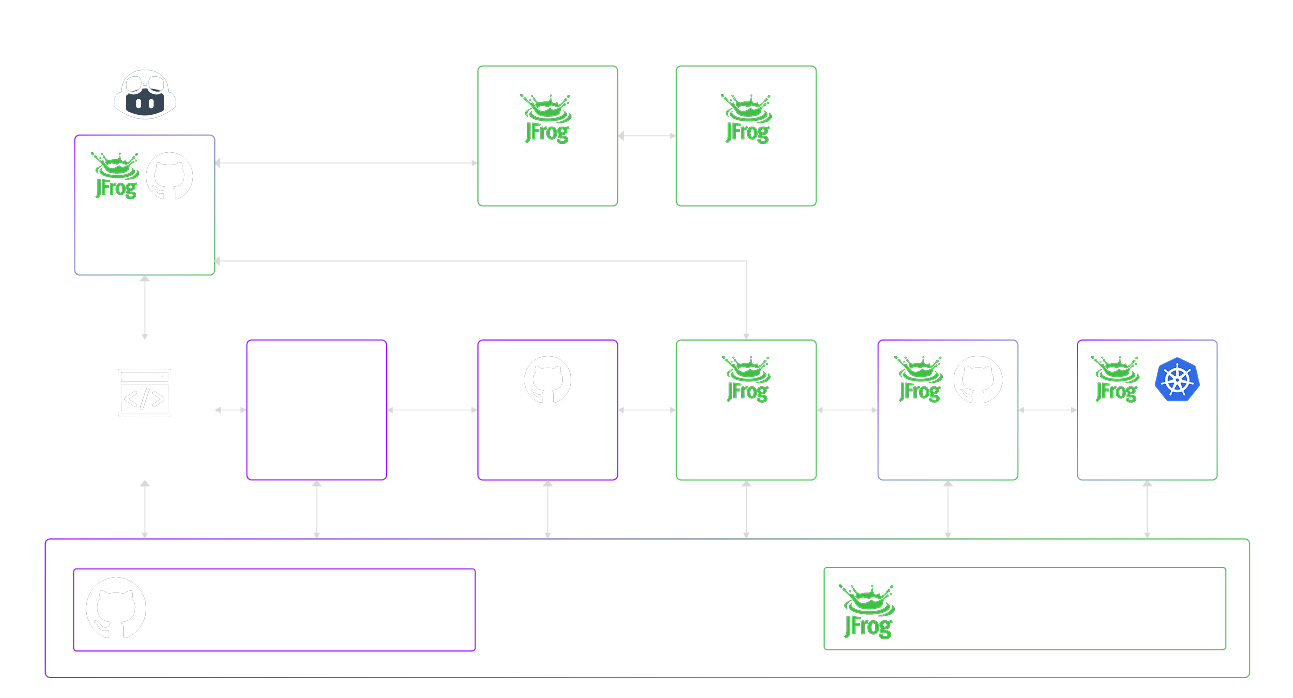
I finally figured out how to implement CI/CD so Pipi can autonomously manage all remote cloud platforms.

  • AWS
  • Azure
  • GCP
  • IBM
  • etc

I was watching a video from the MLOPs community email that led me to JFrog (very useful), which led me to GitHub Actions. I had been looking for a way to enable Pipi 9 to autonomously control any Cloud Platform, but I did not know the correct technical terms, so I was asking the wrong questions. It's one of the disadvantages of being completely self-taught.

Use GitHub Actions

According to Google AI ..."

GitHub Actions can effectively control both Google Cloud Platform (GCP) and Amazon Web Services (AWS) Command Line Interfaces (CLIs) within your CI/CD workflows. This enables automation of cloud resource management, deployments, and other cloud-related tasks directly from your GitHub repositories.

  • Controlling AWS CLI with GitHub Actions:
  • Configure AWS Credentials:
  • Store your AWS Access Key ID and Secret Access Key as GitHub Secrets in your repository settings.

Use the aws-actions/configure-aws-credentials action to configure the AWS CLI with these secrets within your workflow. This action handles the secure setup of credentials for subsequent AWS CLI commands.

Execute AWS CLI Commands:

Once credentials are configured, you can use the run step in your workflow to execute any AWS CLI command.

Example:

Code

        - name: Configure AWS Credentials
          uses: aws-actions/configure-aws-credentials@v1
          with:
            aws-access-key-id: ${{ secrets.AWS_ACCESS_KEY_ID }}
            aws-secret-access-key: ${{ secrets.AWS_SECRET_ACCESS_KEY }}
            aws-region: us-east-1

        - name: List S3 Buckets
          run: aws s3 ls

Controlling GCP CLI (gcloud) with GitHub Actions:

Authenticate to GCP:

Store your GCP Service Account Key (JSON format) as a GitHub Secret.
Use the google-github-actions/auth action to authenticate your workflow to GCP using this service account key.

Setup gcloud CLI:

Use the google-github-actions/setup-gcloud action to install and configure the gcloud CLI within your workflow. You can specify the desired gcloud version and project ID.

Execute gcloud Commands:

After authentication and gcloud setup, you can use the run step to execute gcloud commands.

Example:

Code

        - name: Authenticate to GCP
          uses: google-github-actions/auth@v1
          with:
            credentials_json: ${{ secrets.GCP_SERVICE_ACCOUNT_KEY }}

        - name: Setup gcloud CLI
          uses: google-github-actions/setup-gcloud@v1
          with:
            project_id: your-gcp-project-id

        - name: List GCS Buckets
          run: gcloud storage ls

Key Considerations:
  • Security: Always use GitHub Secrets to store sensitive credentials and implement the principle of least privilege for your cloud service accounts/IAM roles. Consider using OpenID Connect (OIDC) for enhanced security with AWS and GCP.
  • Actions Marketplace: Leverage pre-built actions from the GitHub Marketplace for common tasks like credential configuration and CLI setup, as demonstrated above.
  • Error Handling: Include error handling and logging in your workflows for better debugging and reliability.
  • Idempotency: Design your cloud operations to be idempotent, ensuring that running the workflow multiple times produces the same desired state without unintended side effects.

JFrog

JFrog looks great. Not cheap, but no one is better at security than the Israelis. They are the best in the world. So using their kit is a no-brainer.

There is no free tier, so plan for future use.

Next Question

  • Pipi can use CFML to easily output any of the code listed above.
  • How does that generated code then get into GitHub Actions?
  • So Pipi 9 can autonomously control GitHub Actions. (or GitLab, etc)
  • Would BoxLang do the job?
  • Am I using the correct technical terms?

Interesting examples

# This workflow uses actions that are not certified by GitHub.
# They are provided by a third-party and are governed by
# separate terms of service, privacy policy, and support
# documentation.

# GitHub recommends pinning actions to a commit SHA.
# To get a newer version, you will need to update the SHA.
# You can also reference a tag or branch, but the action may change without warning.

name: Build and Deploy to GKE

on:
  push:
    branches:
      - main

env:
  PROJECT_ID: ${{ secrets.GKE_PROJECT }}
  GKE_CLUSTER: cluster-1    # Add your cluster name here.
  GKE_ZONE: us-central1-c   # Add your cluster zone here.
  DEPLOYMENT_NAME: gke-test # Add your deployment name here.
  IMAGE: static-site

jobs:
  setup-build-publish-deploy:
    name: Setup, Build, Publish, and Deploy
    runs-on: ubuntu-latest
    environment: production

    steps:
    - name: Checkout
      uses: actions/checkout@v5

    # Setup gcloud CLI
    - uses: google-github-actions/setup-gcloud@1bee7de035d65ec5da40a31f8589e240eba8fde5
      with:
        service_account_key: ${{ secrets.GKE_SA_KEY }}
        project_id: ${{ secrets.GKE_PROJECT }}

    # Configure Docker to use the gcloud command-line tool as a credential
    # helper for authentication
    - run: |-
        gcloud --quiet auth configure-docker

    # Get the GKE credentials so we can deploy to the cluster
    - uses: google-github-actions/get-gke-credentials@db150f2cc60d1716e61922b832eae71d2a45938f
      with:
        cluster_name: ${{ env.GKE_CLUSTER }}
        location: ${{ env.GKE_ZONE }}
        credentials: ${{ secrets.GKE_SA_KEY }}

    # Build the Docker image
    - name: Build
      run: |-
        docker build \
          --tag "gcr.io/$PROJECT_ID/$IMAGE:$GITHUB_SHA" \
          --build-arg GITHUB_SHA="$GITHUB_SHA" \
          --build-arg GITHUB_REF="$GITHUB_REF" \
          .

    # Push the Docker image to Google Container Registry
    - name: Publish
      run: |-
        docker push "gcr.io/$PROJECT_ID/$IMAGE:$GITHUB_SHA"

    # Set up kustomize
    - name: Set up Kustomize
      run: |-
        curl -sfLo kustomize https://github.com/kubernetes-sigs/kustomize/releases/download/v3.1.0/kustomize_3.1.0_linux_amd64
        chmod u+x ./kustomize

    # Deploy the Docker image to the GKE cluster
    - name: Deploy
      run: |-
        ./kustomize edit set image gcr.io/PROJECT_ID/IMAGE:TAG=gcr.io/$PROJECT_ID/$IMAGE:$GITHUB_SHA
        ./kustomize build . | kubectl apply -f -
        kubectl rollout status deployment/$DEPLOYMENT_NAME
        kubectl get services -o wide

BoxLang and GitHub Actions

According to Google AI ..."

BoxLang projects can leverage GitHub Actions for Continuous Integration and Continuous Deployment (CI/CD) workflows. Ortus Solutions, the creators of BoxLang, provide a dedicated GitHub Action to simplify this process.

Key features and steps for CI/CD with BoxLang and GitHub Actions:

Setup BoxLang GitHub Action: This action streamlines the setup of the BoxLang Dynamic JVM Language runtime within your CI/CD workflows. It handles the installation of Java, BoxLang binaries, and necessary modules. You can specify the desired BoxLang version (latest stable, snapshots, or specific versions) and automatically manage module installations.

Code

    - name: Setup BoxLang
      uses: ortus-boxlang/setup-boxlang@v1 # Use the appropriate version
      with:
        boxlang-version: 'latest' # Or a specific version like '1.0.0'
        commandbox-version: 'latest' # Optional: if you use CommandBox
        install-modules: 'my-module,another-module' # Optional: install specific BoxLang modules

Define Workflow in YAML: Create a YAML file in your repository's .github/workflows directory to define your CI/CD workflow. This file specifies the events that trigger the workflow (e.g., push to main, pull request), the jobs to run, and the steps within each job.

Build and Test: Within your workflow, you can define steps to build your BoxLang project, run unit tests, and perform any other automated tests. The setup-boxlang action ensures the BoxLang environment is ready for these tasks.

Deployment (CD): For continuous deployment, you can add steps to deploy your BoxLang application to a target environment (e.g., a server, cloud platform like AWS Lambda). This might involve building a deployable artifact, uploading it, and triggering deployment scripts or services.

Code

    - name: Build BoxLang Project
      run: boxlang build # Or your specific build command
    - name: Run Tests
      run: boxlang test # Or your specific test command
    - name: Deploy to AWS Lambda
      # Example using a custom script or another action for deployment
      run: ./deploy-to-lambda.sh
      env:
        AWS_ACCESS_KEY_ID: ${{ secrets.AWS_ACCESS_KEY_ID }}
        AWS_SECRET_ACCESS_KEY: ${{ secrets.AWS_SECRET_ACCESS_KEY }}

Secrets Management: Store sensitive information like API keys or deployment credentials in GitHub Secrets and securely access them within your workflow using expressions like ${{ secrets.MY_SECRET_NAME }}.

By using the setup-boxlang GitHub Action, the process of integrating BoxLang into your CI/CD pipelines becomes significantly simplified, allowing you to focus on developing your application rather than managing environment setup.

Agents in Production was excellent

Mike's Notes

Some initial reflections. I will add to this post over the coming week.

Resources

References

  • Reference

Repository

  • Home > Ajabbi Research > Library >
  • Home > Handbook > 

Last Updated

21/11/2025

Agents in Production was excellent

By: Mike Peters
On a Sandy Beach: 20/11/2025

Mike is the inventor and architect of Pipi and the founder of Ajabbi.

I attended the online MLOps event "Agents in Production held yesterday. It was hosted in the Netherlands. It started at 3am NZ time, so I missed most of it. But all the videos will be available soon, and I'll watch them all.

It was fantastic. The 30 speakers were leaders from engineering teams from every major AI company. NVIDIA, Google, Meta, OpenAI, Microsoft, Redis, Databook, Prosus, etc.

All talking about agents in depth. Lots of architecture here. The audience was even broader, as great questions came through.

This was about building AI itself and solving its problems.

It was fascinating. 

I also found a solution to a big problem for Ajabbi: finding people who can help do this work. In this room, there were plenty of people. Now I know where to look.

It was a lucky moment. I don't recall how I found out about this community and event. Maybe. I got an invite. Next event, I will be better prepped and have questions to post in the Q&A. Will also figure out how to contact other participants.

I look forward to meeting them.

Bolt on

I also had another epiphany last night while sleeping. I could use some of these LLMs as input into Pipi 9, combining the strengths of both. This also confirms what I have been learning from testing Krobar.

Tristan, I might have a job for you. :)

I had been thinking about outputting to an LLM, but it never occurred to me to go the other way until I watched these talks and worked it out visually.