Ten Laws That Govern Enterprise Architecture

Mike's Notes

Still relevant today. Does anyone know if Roger Sessions is still around? I would love to meet him,

Resources

References

  • Reference

Repository

  • Home > Ajabbi Research > Library > Authors > Roger Sessions
  • Home > Handbook > 

Last Updated

27/12/2025

Ten Laws That Govern Enterprise Architecture

By: Roger Sessions
LinkedIn: 24/06/2016

Lead Architect of the IT Simplification Initiative (ITSI), leveraging mathematics to build simpler IT..

Every engineering discipline is governed by specific mathematical laws. Bridge designers must understand the laws of Tension and Compression. Any bridge designed in violation of these laws will collapse. Rocket ship designers must understand Newton’s Laws of Motion. Any rocket ship designed in violation of Newton’s laws will destruct. Aqueduct designers must understand the Laws of Hydraulics. Any aqueduct designed in violation of these laws will block.

How many people would knowingly drive on bridges that violate the laws of Tension and Compression? How many would ride a rocket ship that ignores Newton’s Laws of Motion? How many would hook up their toilet to aqueducts designed by people who poo-poo the laws of Hydraulics?

Like these engineering disciplines, enterprise architecture is governed by specific mathematical laws. However in marked contrast to these other disciplines, few enterprise architects understand the laws that govern their field. Even fewer executives demand that the high cost designs they are funding take into account the most fundamental laws that will determine their success.

This article is a Call to Action. It is a call to enterprise architects to start designing systems that conform to those laws rather than flaunting them. It is a call to executives to start demanding that all designs be subject to a proof of conformity to these laws. To design a large IT system that violates the Laws of Complexity is every bit as negligent as designing a bridge that violates the Laws of Tension and Compression.

As a starting point for this critical discussion, here are what I believe are the ten most important Laws of Complexity:

  1. Complexity = Functional Complexity + Dependency Complexity
  2. Viability = c /Complexity
  3. Value = Useful Functionality / Complexity
  4. Complexity increases exponentially
  5. Capacity to Manage Complexity increases linearly
  6. When partitioning independent elements, partition complexity is driven by subset size.
  7. When partitioning dependent elements, partition complexity is driven by element assignment.
  8. |Non-Optimal Partitions (NOPs)| >> |Optimal Partitions (OPs)|
  9. Complexity (NOPs) >> Complexity (OPs)
  10. OPs can only be found with directed methodologies.

I will write about these laws in more detail in upcoming articles. Stay tuned!

Why Software Fails

Mike's Notes

One of the classics. Still true today. Very wise words from Robert N. Charette.

Resources

References

  • Reference

Repository

  • Home > Ajabbi Research > Library > Authors > Roger Sessions
  • Home > Ajabbi Research > Library > Authors > Robert N. Charette
  • Home > Handbook > 

Last Updated

26/12/2025

Why Software Fails

By: Robert N. Charette
IEEE Spectrum: 01/09/2005

Robert N. Charette is a Contributing Editor to IEEE Spectrum and an acknowledged international authority on information technology and systems risk management. A self-described “risk ecologist,” he is interested in the intersections of business, political, technological, and societal risks. Charette is an award-winning author of multiple books and numerous articles on the subjects of risk management, project and program management, innovation, and entrepreneurship. A Life Senior Member of the IEEE, Charette was a recipient of the IEEE Computer Society’s Golden Core Award in 2008.

We waste billions of dollars each year on entirely preventable mistakes

Have you heard the one about the disappearing warehouse? One day, it vanished—not from physical view, but from the watchful eyes of a well-known retailer’s automated distribution system. A software glitch had somehow erased the warehouse’s existence, so that goods destined for the warehouse were rerouted elsewhere, while goods at the warehouse languished. Because the company was in financial trouble and had been shuttering other warehouses to save money, the employees at the “missing” warehouse kept quiet. For three years, nothing arrived or left. Employees were still getting their paychecks, however, because a different computer system handled the payroll. When the software glitch finally came to light, the merchandise in the warehouse was sold off, and upper management told employees to say nothing about the episode.

Person pushes shopping cart inside Sainsbury's, with orange welcome sign and stacked carts nearby.

MARKET CRASH: After its new automated supply-chain management system failed last October, leaving merchandise stuck in company warehouses, British food retailer Sainsbury’s had to hire 3000 additional clerks to stock its shelves.GRAHAM BARCLAY/BLOOMBERG NEWS/LANDOV

This story has been floating around the information technology industry for 20-some years. It’s probably apocryphal, but for those of us in the business, it’s entirely plausible. Why? Because episodes like this happen all the time. Last October, for instance, the giant British food retailer J Sainsbury PLC had to write off its US $526 million investment in an automated supply-chain management system. It seems that merchandise was stuck in the company’s depots and warehouses and was not getting through to many of its stores. Sainsbury was forced to hire about 3000 additional clerks to stock its shelves manually [see photo above, "Market Crash"].

Software Hall of Shame

List of software failures from 1992-2005 with costs and business consequences.

Sources: Business Week, CEO Magazine, Computerworld, InfoWeek, Fortune, The New York Times, Time, and The Wall Street Journal * Converted to U.S. dollars using current exchange rates as of press time. † Converted to U.S. dollars using exchange rates for the year cited, according to the International Trade Administration, U.S. Department of Commerce. ** Converted to U.S. dollars using exchange rates for the year cited, according to the Statistical Abstract of the United States, 1996 .

This is only one of the latest in a long, dismal history of IT projects gone awry [see table above, "Software Hall of Shame" for other notable fiascoes]. Most IT experts agree that such failures occur far more often than they should. What’s more, the failures are universally unprejudiced: they happen in every country; to large companies and small; in commercial, nonprofit, and governmental organizations; and without regard to status or reputation. The business and societal costs of these failures—in terms of wasted taxpayer and shareholder dollars as well as investments that can’t be made—are now well into the billions of dollars a year.

The problem only gets worse as IT grows ubiquitous. This year, organizations and governments will spend an estimated $1 trillion on IT hardware, software, and services worldwide. Of the IT projects that are initiated, from 5 to 15 percent will be abandoned before or shortly after delivery as hopelessly inadequate. Many others will arrive late and over budget or require massive reworking. Few IT projects, in other words, truly succeed.

The biggest tragedy is that software failure is for the most part predictable and avoidable. Unfortunately, most organizations don’t see preventing failure as an urgent matter, even though that view risks harming the organization and maybe even destroying it. Understanding why this attitude persists is not just an academic exercise; it has tremendous implications for business and society.

SOFTWARE IS EVERYWHERE. It’s what lets us get cash from an ATM, make a phone call, and drive our cars. A typical cellphone now contains 2 million lines of software code; by 2010 it will likely have 10 times as many. General Motors Corp. estimates that by then its cars will each have 100 million lines of code.

The average company spends about 4 to 5 percent of revenue on information technology, with those that are highly IT dependent—such as financial and telecommunications companies—spending more than 10 percent on it. In other words, IT is now one of the largest corporate expenses outside employee costs. Much of that money goes into hardware and software upgrades, software license fees, and so forth, but a big chunk is for new software projects meant to create a better future for the organization and its customers.

Governments, too, are big consumers of software. In 2003, the United Kingdom had more than 100 major government IT projects under way that totaled $20.3 billion. In 2004, the U.S. government cataloged 1200 civilian IT projects costing more than $60 billion, plus another $16 billion for military software.

Any one of these projects can cost over $1 billion. To take two current examples, the computer modernization effort at the U.S. Department of Veterans Affairs is projected to run $3.5 billion, while automating the health records of the UK’s National Health Service is likely to cost more than $14.3 billion for development and another $50.8 billion for deployment.

Such megasoftware projects, once rare, are now much more common, as smaller IT operations are joined into “systems of systems.” Air traffic control is a prime example, because it relies on connections among dozens of networks that provide communications, weather, navigation, and other data. But the trick of integration has stymied many an IT developer, to the point where academic researchers increasingly believe that computer science itself may need to be rethought in light of these massively complex systems.

When a project fails , it jeopardizes an organization’s prospects. If the failure is large enough, it can steal the company’s entire future. In one stellar meltdown, a poorly implemented resource planning system led FoxMeyer Drug Co., a $5 billion wholesale drug distribution company in Carrollton, Texas, to plummet into bankruptcy in 1996.

IT failure in government can imperil national security, as the FBI’s Virtual Case File debacle has shown. The $170 million VCF system, a searchable database intended to allow agents to “connect the dots” and follow up on disparate pieces of intelligence, instead ended five months ago without any system’s being deployed [see “Who Killed the Virtual Case File?" in this issue].

IT failures can also stunt economic growth and quality of life. Back in 1981, the U.S. Federal Aviation Administration began looking into upgrading its antiquated air-traffic-control system, but the effort to build a replacement soon became riddled with problems [see photo, "Air Jam," at top of this article]. By 1994, when the agency finally gave up on the project, the predicted cost had tripled, more than $2.6 billion had been spent, and the expected delivery date had slipped by several years. Every airplane passenger who is delayed because of gridlocked skyways still feels this cancellation; the cumulative economic impact of all those delays on just the U.S. airlines (never mind the passengers) approaches $50 billion.

Worldwide, it’s hard to say how many software projects fail or how much money is wasted as a result. If you define failure as the total abandonment of a project before or shortly after it is delivered, and if you accept a conservative failure rate of 5 percent, then billions of dollars are wasted each year on bad software.

For example, in 2004, the U.S. government spent $60 billion on software (not counting the embedded software in weapons systems); a 5 percent failure rate means $3 billion was probably wasted. However, after several decades as an IT consultant, I am convinced that the failure rate is 15 to 20 percent for projects that have budgets of $10 million or more. Looking at the total investment in new software projects—both government and corporate—over the last five years, I estimate that project failures have likely cost the U.S. economy at least $25 billion and maybe as much as $75 billion.

Of course, that $75 billion doesn’t reflect projects that exceed their budgets—which most projects do. Nor does it reflect projects delivered late—which the majority are. It also fails to account for the opportunity costs of having to start over once a project is abandoned or the costs of bug-ridden systems that have to be repeatedly reworked.

Then, too, there’s the cost of litigation from irate customers suing suppliers for poorly implemented systems. When you add up all these extra costs, the yearly tab for failed and troubled software conservatively runs somewhere from $60 billion to $70 billion in the United States alone. For that money, you could launch the space shuttle 100 times, build and deploy the entire 24-satellite Global Positioning System, and develop the Boeing 777 from scratch—and still have a few billion left over.

Why do projects fail so often?

Among the most common factors:

  • Unrealistic or unarticulated project goals
  • Inaccurate estimates of needed resources
  • Badly defined system requirements
  • Poor reporting of the project’s status
  • Unmanaged risks
  • Poor communication among customers, developers, and users
  • Use of immature technology
  • Inability to handle the project’s complexity
  • Sloppy development practices
  • Poor project management
  • Stakeholder politics
  • Commercial pressures

Of course, IT projects rarely fail for just one or two reasons. The FBI’s VCF project suffered from many of the problems listed above. Most failures, in fact, can be traced to a combination of technical, project management, and business decisions. Each dimension interacts with the others in complicated ways that exacerbate project risks and problems and increase the likelihood of failure.

Consider a simple software chore: a purchasing system that automates the ordering, billing, and shipping of parts, so that a salesperson can input a customer’s order, have it automatically checked against pricing and contract requirements, and arrange to have the parts and invoice sent to the customer from the warehouse.

The requirements for the system specify four basic steps. First, there’s the sales process, which creates a bill of sale. That bill is then sent through a legal process, which reviews the contractual terms and conditions of the potential sale and approves them. Third in line is the provision process, which sends out the parts contracted for, followed by the finance process, which sends out an invoice.

Let’s say that as the first process, for sales, is being written, the programmers treat every order as if it were placed in the company’s main location, even though the company has branches in several states and countries. That mistake, in turn, affects how tax is calculated, what kind of contract is issued, and so on.

The sooner the omission is detected and corrected, the better. It’s kind of like knitting a sweater. If you spot a missed stitch right after you make it, you can simply unravel a bit of yarn and move on. But if you don’t catch the mistake until the end, you may need to unravel the whole sweater just to redo that one stitch.

If the software coders don’t catch their omission until final system testing—or worse, until after the system has been rolled out—the costs incurred to correct the error will likely be many times greater than if they’d caught the mistake while they were still working on the initial sales process.

And unlike a missed stitch in a sweater, this problem is much harder to pinpoint; the programmers will see only that errors are appearing, and these might have several causes. Even after the original error is corrected, they’ll need to change other calculations and documentation and then retest every step.

In fact, studies have shown that software specialists spend about 40 to 50 percent of their time on avoidable rework rather than on what they call value-added work, which is basically work that’s done right the first time. Once a piece of software makes it into the field, the cost of fixing an error can be 100 times as high as it would have been during the development stage.

If errors abound, then rework can start to swamp a project, like a dinghy in a storm. What’s worse, attempts to fix an error often introduce new ones. It’s like you’re bailing out that dinghy, but you’re also creating leaks. If too many errors are produced, the cost and time needed to complete the system become so great that going on doesn’t make sense.

In the simplest terms, an IT project usually fails when the rework exceeds the value-added work that’s been budgeted for. This is what happened to Sydney Water Corp., the largest water provider in Australia, when it attempted to introduce an automated customer information and billing system in 2002 [see box, "Case Study #2"]. According to an investigation by the Australian Auditor General, among the factors that doomed the project were inadequate planning and specifications, which in turn led to numerous change requests and significant added costs and delays. Sydney Water aborted the project midway, after spending AU $61 million (US $33.2 million).

All of which leads us to the obvious question: why do so many errors occur?

Software project failures have a lot in common with airplane crashes. Just as pilots never intend to crash, software developers don’t aim to fail. When a commercial plane crashes, investigators look at many factors, such as the weather, maintenance records, the pilot’s disposition and training, and cultural factors within the airline. Similarly, we need to look at the business environment, technical management, project management, and organizational culture to get to the roots of software failures.

Chief among the business factors are competition and the need to cut costs. Increasingly, senior managers expect IT departments to do more with less and do it faster than before; they view software projects not as investments but as pure costs that must be controlled.

Political exigencies can also wreak havoc on an IT project’s schedule, cost, and quality. When Denver International Airport attempted to roll out its automated baggage-handling system, state and local political leaders held the project to one unrealistic schedule after another. The failure to deliver the system on time delayed the 1995 opening of the airport (then the largest in the United States), which compounded the financial impact manyfold.

Even after the system was completed, it never worked reliably: it chewed up baggage, and the carts used to shuttle luggage around frequently derailed. Eventually, United Airlines, the airport’s main tenant, sued the system contractor, and the episode became a testament to the dangers of political expediency.

A lack of upper-management support can also damn an IT undertaking. This runs the gamut from failing to allocate enough money and manpower to not clearly establishing the IT project’s relationship to the organization’s business. In 2000, retailer Kmart Corp., in Troy, Mich., launched a $1.4 billion IT modernization effort aimed at linking its sales, marketing, supply, and logistics systems, to better compete with rival Wal-Mart Corp., in Bentonville, Ark. Wal-Mart proved too formidable, though, and 18 months later, cash-strapped Kmart cut back on modernization, writing off the $130 million it had already invested in IT. Four months later, it declared bankruptcy; the company continues to struggle today.

Frequently, IT project managers eager to get funded resort to a form of liar’s poker, overpromising what their project will do, how much it will cost, and when it will be completed. Many, if not most, software projects start off with budgets that are too small. When that happens, the developers have to make up for the shortfall somehow, typically by trying to increase productivity, reducing the scope of the effort, or taking risky shortcuts in the review and testing phases. These all increase the likelihood of error and, ultimately, failure.

A state-of-the-art travel reservation system spearheaded by a consortium of Budget Rent-A-Car, Hilton Hotels, Marriott, and AMR, the parent of American Airlines, is a case in point. In 1992, three and a half years and $165 million into the project, the group abandoned it, citing two main reasons: an overly optimistic development schedule and an underestimation of the technical difficulties involved. This was the same group that had earlier built the hugely successful Sabre reservation system, proving that past performance is no guarantee of future results.

After crash investigators consider the weather as a factor in a plane crash, they look at the airplane itself. Was there something in the plane’s design that caused the crash? Was it carrying too much weight?

In IT project failures, similar questions invariably come up regarding the project’s technical components: the hardware and software used to develop the system and the development practices themselves. Organizations are often seduced by the siren song of the technological imperative—the uncontrollable urge to use the latest technology in hopes of gaining a competitive edge. With technology changing fast and promising fantastic new capabilities, it is easy to succumb. But using immature or untested technology is a sure route to failure.

In 1997, after spending $40 million, the state of Washington shut down an IT project that would have processed driver’s licenses and vehicle registrations. Motor vehicle officials admitted that they got caught up in chasing technology instead of concentrating on implementing a system that met their requirements. The IT debacle that brought down FoxMeyer Drug a year earlier also stemmed from adopting a state-of-the-art resource-planning system and then pushing it beyond what it could feasibly do.

A project’s sheer size is a fountainhead of failure. Studies indicate that large-scale projects fail three to five times more often than small ones. The larger the project, the more complexity there is in both its static elements (the discrete pieces of software, hardware, and so on) and its dynamic elements (the couplings and interactions among hardware, software, and users; connections to other systems; and so on). Greater complexity increases the possibility of errors, because no one really understands all the interacting parts of the whole or has the ability to test them.

Sobering but true: it’s impossible to thoroughly test an IT system of any real size. Roger S. Pressman pointed out in his book Software Engineering, one of the classic texts in the field, that “exhaustive testing presents certain logistical problems....Even a small 100-line program with some nested paths and a single loop executing less than twenty times may require 10 to the power of 14 possible paths to be executed.” To test all of those 100 trillion paths, he noted, assuming each could be evaluated in a millisecond, would take 3170 years.

All IT systems are intrinsically fragile. In a large brick building, you’d have to remove hundreds of strategically placed bricks to make a wall collapse. But in a 100 000-line software program, it takes only one or two bad lines to produce major problems. In 1991, a portion of ATandamp;T’s telephone network went out, leaving 12 million subscribers without service, all because of a single mistyped character in one line of code.

Sloppy development practices are a rich source of failure, and they can cause errors at any stage of an IT project. To help organizations assess their software-development practices, the U.S. Software Engineering Institute, in Pittsburgh, created the Capability Maturity Model, or CMM. It rates a company’s practices against five levels of increasing maturity. Level 1 means the organization is using ad hoc and possibly chaotic development practices. Level 3 means the company has characterized its practices and now understands them. Level 5 means the organization quantitatively understands the variations in the processes and practices it applies.

As of January, nearly 2000 government and commercial organizations had voluntarily reported CMM levels. Over half acknowledged being at either level 1 or 2, 30 percent were at level 3, and only 17 percent had reached level 4 or 5. The percentages are even more dismal when you realize that this is a self-selected group; obviously, companies with the worst IT practices won’t subject themselves to a CMM evaluation. (The CMM is being superseded by the CMM-Integration, which aims for a broader assessment of an organization’s ability to create software-intensive systems.)

Immature IT practices doomed the U.S. Internal Revenue Service’s $4 billion modernization effort in 1997, and they have continued to plague the IRS’s current $8 billion modernization. It may just be intrinsically impossible to translate the tax code into software code—tax law is complex and based on often-vague legislation, and it changes all the time. From an IT developer’s standpoint, it’s a requirements nightmare. But the IRS hasn’t been helped by open hostility between in-house and outside programmers, a laughable underestimation of the work involved, and many other bad practices.

THE PILOT’S ACTIONS JUST BEFORE a plane crashes are always of great interest to investigators. That’s because the pilot is the ultimate decision-maker, responsible for the safe operation of the craft. Similarly, project managers play a crucial role in software projects and can be a major source of errors that lead to failure.

Back in 1986, the London Stock Exchange decided to automate its system for settling stock transactions. Seven years later, after spending $600 million, it scrapped the Taurus system’s development, not only because the design was excessively complex and cumbersome but also because the management of the project was, to use the word of one of its own senior managers, “delusional.” As investigations revealed, no one seemed to want to know the true status of the project, even as more and more problems appeared, deadlines were missed, and costs soared [see box, "Case Study #3"].

The most important function of the IT project manager is to allocate resources to various activities. Beyond that, the project manager is responsible for project planning and estimation, control, organization, contract management, quality management, risk management, communications, and human resource management.

Bad decisions by project managers are probably the single greatest cause of software failures today. Poor technical management, by contrast, can lead to technical errors, but those can generally be isolated and fixed. However, a bad project management decision—such as hiring too few programmers or picking the wrong type of contract—can wreak havoc. For example, the developers of the doomed travel reservation system claim that they were hobbled in part by the use of a fixed-price contract. Such a contract assumes that the work will be routine; the reservation system turned out to be anything but.

Project management decisions are often tricky precisely because they involve tradeoffs based on fuzzy or incomplete knowledge. Estimating how much an IT project will cost and how long it will take is as much art as science. The larger or more novel the project, the less accurate the estimates. It’s a running joke in the industry that IT project estimates are at best within 25 percent of their true value 75 percent of the time.

There are other ways that poor project management can hasten a software project’s demise. A study by the Project Management Institute, in Newton Square, Pa., showed that risk management is the least practiced of all project management disciplines across all industry sectors, and nowhere is it more infrequently applied than in the IT industry. Without effective risk management, software developers have little insight into what may go wrong, why it may go wrong, and what can be done to eliminate or mitigate the risks. Nor is there a way to determine what risks are acceptable, in turn making project decisions regarding tradeoffs almost impossible.

Poor project management takes many other forms, including bad communication, which creates an inhospitable atmosphere that increases turnover; not investing in staff training; and not reviewing the project’s progress at regular intervals. Any of these can help derail a software project.

The last area that investigators look into after a plane crash is the organizational environment. Does the airline have a strong safety culture, or does it emphasize meeting the flight schedule above all? In IT projects, an organization that values openness, honesty, communication, and collaboration is more apt to find and resolve mistakes early enough that rework doesn’t become overwhelming.

If there’s a theme that runs through the tortured history of bad software, it’s a failure to confront reality. On numerous occasions, the U.S. Department of Justice’s inspector general, an outside panel of experts, and others told the head of the FBI that the VCF system was impossible as defined, and yet the project continued anyway. The same attitudes existed among those responsible for the travel reservation system, the London Stock Exchange’s Taurus system, and the FAA’s air-traffic-control project—all indicative of organizational cultures driven by fear and arrogance.

A recent report by the National Audit Office in the UK found numerous cases of government IT projects’ being recommended not to go forward yet continuing anyway. The UK even has a government department charged with preventing IT failures, but as the report noted, more than half of the agencies the department oversees routinely ignore its advice. I call this type of behavior irrational project escalation—the inability to stop a project even after it’s obvious that the likelihood of success is rapidly approaching zero. Sadly, such behavior is in no way unique.

In the final analysis , big software failures tend to resemble the worst conceivable airplane crash, where the pilot was inexperienced but exceedingly rash, flew into an ice storm in an untested aircraft, and worked for an airline that gave lip service to safety while cutting back on training and maintenance. If you read the investigator’s report afterward, you’d be shaking your head and asking, “Wasn’t such a crash inevitable?”

So, too, the reasons that software projects fail are well known and have been amply documented in countless articles, reports, and books [see sidebar, To Probe Further]. And yet, failures, near-failures, and plain old bad software continue to plague us, while practices known to avert mistakes are shunned. It would appear that getting quality software on time and within budget is not an urgent priority at most organizations.

It didn’t seem to be at Oxford Health Plans Inc., in Trumbull, Conn., in 1997. The company’s automated billing system was vital to its bottom line, and yet senior managers there were more interested in expanding Oxford’s business than in ensuring that its billing system could meet its current needs [see box, "Case Study #1"]. Even as problems arose, such as invoices’ being sent out months late, managers paid little attention. When the billing system effectively collapsed, the company lost tens of millions of dollars, and its stock dropped from $68 to $26 per share in one day, wiping out $3.4 billion in corporate value. Shareholders brought lawsuits, and several government agencies investigated the company, which was eventually fined $3 million for regulatory violations.

Even organizations that get burned by bad software experiences seem unable or unwilling to learn from their mistakes. In a 2000 report, the U.S. Defense Science Board, an advisory body to the Department of Defense, noted that various studies commissioned by the DOD had made 134 recommendations for improving its software development, but only 21 of those recommendations had been acted on. The other 113 were still valid, the board noted, but were being ignored, even as the DOD complained about the poor state of defense software development!

Some organizations do care about software quality, as the experience of the software development firm Praxis High Integrity Systems, in Bath, England, proves. Praxis demands that its customers be committed to the project, not only financially, but as active participants in the IT system’s creation. The company also spends a tremendous amount of time understanding and defining the customer’s requirements, and it challenges customers to explain what they want and why. Before a single line of code is written, both the customer and Praxis agree on what is desired, what is feasible, and what risks are involved, given the available resources.

After that, Praxis applies a rigorous development approach that limits the number of errors. One of the great advantages of this model is that it filters out the many would-be clients unwilling to accept the responsibility of articulating their IT requirements and spending the time and money to implement them properly. [See “The Exterminators," in this issue.]

Some level of software failure will always be with us. Indeed, we need true failures—as opposed to avoidable blunders—to keep making technical and economic progress. But too many of the failures that occur today are avoidable. And as our society comes to rely on IT systems that are ever larger, more integrated, and more expensive, the cost of failure may become disastrously high.

Even now, it’s possible to take bets on where the next great software debacle will occur. One of my leading candidates is the IT systems that will result from the U.S. government’s American Health Information Community, a public-private collaboration that seeks to define data standards for electronic medical records. The idea is that once standards are defined, IT systems will be built to let medical professionals across the country enter patient records digitally, giving doctors, hospitals, insurers, and other health-care specialists instant access to a patient’s complete medical history. Health-care experts believe such a system of systems will improve patient care, cut costs by an estimated $78 billion per year, and reduce medical errors, saving tens of thousands of lives.

But this approach is a mere pipe dream if software practices and failure rates remain as they are today. Even by the most optimistic estimates, to create an electronic medical record system will require 10 years of effort, $320 billion in development costs, and $20 billion per year in operating expenses—assuming that there are no failures, overruns, schedule slips, security issues, or shoddy software. This is hardly a realistic scenario, especially because most IT experts consider the medical community to be the least computer-savvy of all professional enterprises.

Patients and taxpayers will ultimately pay the price for the development, or the failure, of boondoggles like this. Given today’s IT practices, failure is a distinct possibility, and it would be a loss of unprecedented magnitude. But then, countries throughout the world are contemplating or already at work on many initiatives of similar size and impact—in aviation, national security, and the military, among other arenas.

Like electricity, water, transportation, and other critical parts of our infrastructure, IT is fast becoming intrinsic to our daily existence. In a few decades, a large-scale IT failure will become more than just an expensive inconvenience: it will put our way of life at risk. In the absence of the kind of industrywide changes that will mitigate software failures, how much of our future are we willing to gamble on these enormously costly and complex systems.

We already know how to do software well. It may finally be time to act on what we know. 

Workspaces for Developers

Mike's Notes

This is where I will keep detailed working notes on creating Workspaces for Developers. Eventually, these will become permanent, better-written documentation stored elsewhere. Hopefully, someone will come up with a better name than this working title.

This replaces the coverage in Industry Workspace dated 13/10/2025.

Testing

The current online mockup is version 3 and will be updated frequently. If you are helping with testing, please remember to delete your browser cache so you see the daily changes. Eventually, a live demo version will be available for field trials.

Learning

(To come)

Why

(To come)

Resources

References


References

  • Reference

Repository

  • Home > Ajabbi Research > Library >
  • Home > Handbook > 

Last Updated

25/12/2025

Workspaces for Developers

By: Mike Peters
On a Sandy Beach: 25/12/2025

Mike is the inventor and architect of Pipi and the founder of Ajabbi.

Open-source

This open-source SaaS cloud system will be shared on GitHub and GitLab.

Dedication

This workspace is dedicated to the life and work of Alan Turing.

Source:

"

" - Wikipedia

Change Log

Ver 3 includes config and tools.

Existing products

Features

This is a basic comparison of features in culture software.

[TABLE]

Data Model

words

Database Entities

  • Facility
  • Party
  • etc

Standards

The workspace must comply with all applicable international standards.

  • (To come)

Support

There will be extensive free documentation sets tailored for different users.

Every user account includes access to customer support when using these modules (which can be enabled or disabled in account settings). 

Workspace navigation menu

This default outline needs significant work. The outline can be easily customised by future users via drag-and-drop and tick boxes to toggle features on and off.

  • Developer Account
    • Applications
      • Config(v.3)
        • API

        • Component Class 

        • Design System

        • Engine
          • ajx
          • alg
          • api
          • apl
          • aui
          • bor
          • brs
          • cde
          • cfg
          • cgi
          • cmd
          • cms
          • cnd
          • cnf
          • cny
          • cor
          • cpt
          • cpx
          • css
          • cte
          • ctx
          • cui
          • dao
          • dmn
          • dob
          • doc
          • dom
          • dpl
          • dsg
          • dta
          • dvp
          • eml
          • eng
          • fac
          • ffg
          • fil
          • fld
          • fnt
          • ftp
          • fui
          • int
          • iot
          • ips
          • kwd
          • lng
          • lnk
          • lob
          • loc
          • log
          • lop
          • lui
          • mim
          • mle
          • mod
          • mpg
          • msg
          • mta
          • mtr
          • nde
          • nsp
          • nte
          • obj
          • ont
          • oop
          • par
          • pge
          • phl
          • pkg
          • pln
          • plt
          • plu
          • plw
          • prm
          • pub
          • pui
          • rbn
          • rgn
          • rle
          • rls
          • rnd
          • scl
          • scr
          • sgp
          • spt
          • ssn
          • sta
          • sys
          • tem
          • tra
          • trn
          • tsk
          • udt
          • usa
          • usi
          • usp
          • usr
          • var
          • vct
          • ver
          • vfy
          • wai
          • wbs
          • wfl
          • wki
          • wsp
        • Entity Class 

        • Module 

        • Plugin
          • AddThis
          • Amazon Book
          • Apple Map
          • Apple Music
          • ArcGIS Map
          • Atlassian Analytics
          • Azure Map
          • CodePen
          • CodeSandbox
          • Confluence
          • Elfsight Weather
          • Flightradar24
          • FormBlock
          • GitHub-Embed
          • GitLab Snippet
          • Google Analytics
          • Google Calendar
          • Google Docs
          • Google Form
          • Google Map
          • Google Meet
          • Google Sheets
          • Google Slides
          • Instagram
          • IUCN Threat Status
          • Jira Advanced Roadmap
          • JSBin
          • Jupyter Notebook
          • MailChimp
          • Metservice Weather
          • Microsft Forms
          • NASA Spot the Station
          • NASA Worldview
          • NetSuite Case Form
          • NIWA CO2 Widget
          • NIWA Tide Widget
          • NIWA UV Widget
          • NIWA Weather Widget
          • Odoo Form
          • PDF
          • PostHog Analytics
          • Survey Monkey
          • Trello Board
          • Trello Card
          • TypeForm
          • Vimeo Video
          • Weather Widget
          • Wolfram Notebook
          • Yandex Map
          • Yandex Video
          • YouTube Video
          • Zoho Calendar
          • Zoho Form
          • Zoom Meeting
      • Tools
        • Build
        • Code
        • Deploy
        • Document
        • Feedback
        • Monitor
        • Operate
        • Plan
        • Release
        • Test
    • Customers (v2)
      • Bookmarks
        • (To come)
      • Support
        • Contact
        • Forum
        • Live Chat
        • Office Hours
        • Requests
        • Tickets
      • (To come)
        • Feature Vote
        • Feedback
        • Surveys
      • Learning
        • Explanation
        • How to Guide
        • Reference
        • Tutorial
      • Settings (v3)
        • Account
        • Billing
        • Deployments
          • Workspaces
            • Modules
            • Plugins
            • Templates
              • Solo
              • Team
              • DevOps
            • Users

    Number of data centers worldwide 2025, by country or territory

    Mike's Notes

    Provides some perspective on the distribution of their current locations. The 2025 data is available as a spreadsheet. 

    It's also a proxy index of electrification and economic development by country.

    Resources

    References

    • Reference

    Repository

    • Home > Ajabbi Research > Library >
    • Home > Handbook > 

    Last Updated

    25/12/2025

    Number of data centers worldwide 2025, by country or territory

    By: Petroc Taylor
    Statistica: 19/11/2025

    Petroc Taylor is a researcher with Statista's Technology and Telecommunications team. His research focus is global developments in the use of data, including trends in big data, analytics, and storage, as well as the impact of emerging data technologies across industries and sectors. He also supports the team's coverage of operating systems, telecommunications, and the technology industry in Africa..

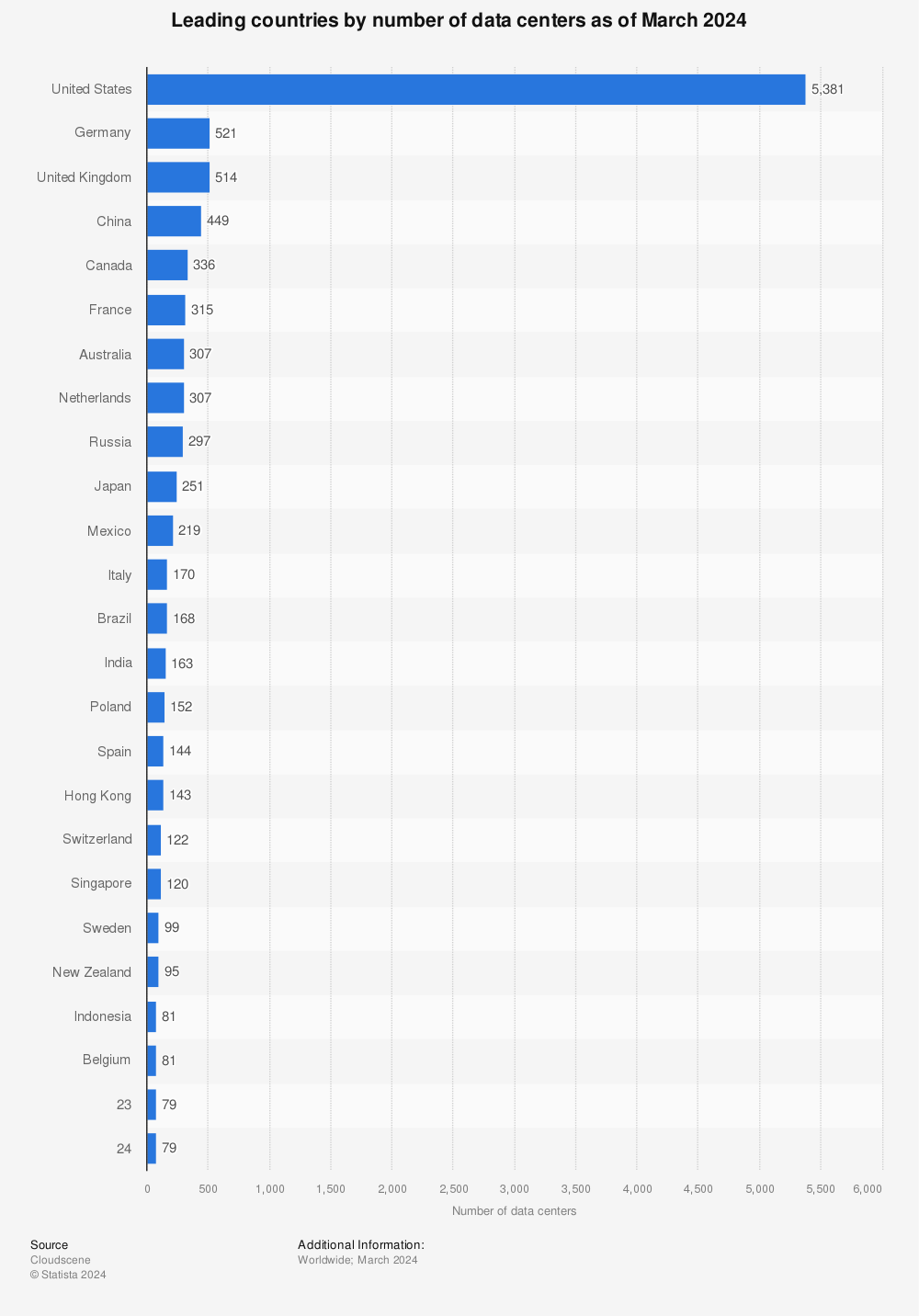
    As of November 2025, there were a reported 4,165 data centers in the United States, the most of any country worldwide. A further 499 were located in the United Kingdom, while 487 were located in Germany.

    What is a data center?

    Data centers are facilities designed to store and compute vast amounts of data efficiently and securely. Growing in importance amid the rise of cloud computing and artificial intelligence, data centers form the core infrastructure powering global digital transformation. Modern data centers consist of critical computing hardware such as servers, storage systems, and networking equipment organized into racks, alongside specialized secondary infrastructure providing power, cooling, and security.

    AI data centers

    Data centers are vital for artificial intelligence, with the world’s leading technology companies investing vast sums in new facilities across the globe. Purpose-built AI data centers provide the immense computing power required to train the most advanced AI models, as well as to process user requests in real time, a task known as inference. Increasing attention has therefore turned to the location of these powerful facilities, as governments grow more concerned with AI sovereignty. At the same time, rapid data center expansion has sparked a global debate over resource use, including land, energy, and water, as modern facilities begin to strain local infrastructure.

    Data

    Statistic: Number of data centers worldwide as of November 2025, by country or territory | Statista

    Find more statistics at Statista

    C4 for documenting architecture

    Mike's Notes

    Pipi is highly complex, with a novel architecture that resembles a moving biological cell, so diagramming to aid understanding will be very challenging.

    The C4 model by Simon Brown may be a valuable tool for Pipi to automatically document itself because it follows simple rules and can zoom in and out. Many other tools will also be needed. Some may have to be invented.

    Chris Richardson's diagrams look useful as well.

    Resources

    References

    • Reference

    Repository

    • Home > Ajabbi Research > Library >
    • Home > Handbook > 

    Last Updated

    23/12/2025

    C4 for documenting architecture

    By: Simon Brown
    C4: 23/12/2025

    I'm the author of Software Architecture for Developers; a developer-friendly guide to software architecture, technical leadership and the balance with agility. I'm also the creator of the C4 software architecture model and the founder of Structurizr, a collection of tooling to help software teams visualise, document and explore their software architecture.

    Ask somebody in the building industry to visually communicate the architecture of a building and you’ll be presented with site plans, floor plans, elevation views, cross-section views and detail drawings. In contrast, ask a software developer to communicate the software architecture of a software system using diagrams and you’ll likely get a confused mess of boxes and lines … inconsistent notation (colour coding, shapes, line styles, etc), ambiguous naming, unlabelled relationships, generic terminology, missing technology choices, mixed abstractions, etc.

    As an industry, we do have the Unified Modeling Language (UML), ArchiMate and SysML, but asking whether these provide an effective way to communicate software architecture is often irrelevant because many teams have already thrown them out in favour of much simpler “boxes and lines” diagrams. Abandoning these modelling languages is one thing but, perhaps in the race for agility, many software development teams have lost the ability to communicate visually.

    Maps of your code

    The C4 model was created as a way to help software development teams describe and communicate software architecture, both during up-front design sessions and when retrospectively documenting an existing codebase. It’s a way to create “maps of your code”, at various levels of detail, in the same way you would use something like Google Maps to zoom in and out of an area you are interested in.

    System Context

    A system context diagram provides a starting point, showing how the software system in scope fits into the world around it.

    Container Diagram

    A container diagram zooms into the software system in scope, showing the applications and data stores inside it.

    Component Diagram

    A component diagram zooms into an individual container, showing the components inside it.

    Code Diagram

    A code diagram (e.g. UML class) can be used to zoom into an individual component, showing how that component is implemented at the code level.

    Uses and benefits

    Good software architecture diagrams assist with communication inside and outside of software development/product teams, efficient onboarding of new staff, architecture reviews/evaluations, risk identification (e.g. risk-storming), threat modelling, etc. The goal of the C4 model is to raise the level of maturity associated with software architecture diagrams.

    Visualising software architecture with the C4 model - Simon Brown, Agile on the Beach 2019

    Long live the aeonophiles!

    Mike's Notes

    Fascinating extreme example of thermodynamics of life pushing systems out of equilibrium.

    Resources

    References

    • Reference

    Repository

    • Home > Ajabbi Research > Library > Subscriptions > Aeon
    • Home > Handbook > 

    Last Updated

    7/01/2026

    Long live the aeonophiles!

    By: Karen G Lloydis
    Aeon: 18/12/2025

    Karen G Lloydis a microbial biogeochemist, focused on discovering and describing life inside Earth’s crust. She is the Wrigley professor of earth sciences, and marine and environmental biology, at the University of Southern California, and the author of Intraterrestrials: Discovering the Strangest Life on Earth (2025)..

    The discovery of organisms that have been alive for many thousands of years requires a revolution in how we understand life

    Promethearchaeum syntrophicum, strain MK-D1, digitally coloured yellow, strain MK-D1. Courtesy Hiroyuki Imachi, Masaru K Nobu, and JAMSTEC

    If you had to nominate the slowest, longest-living organisms on Earth, what would you picture? Among the vertebrates, some people might think of tortoises, whales or perhaps more obscure creatures like the Greenland shark, which can live for centuries. Others might imagine coral colonies, or perhaps an ancient tree: there are oaks in England that could be more than 1,000 years old, whereas in California, a few Bristlecone pines have been around for millennia, dating to around the formation of ancient Egypt.

    But how about bacteria? Microbes, at the outset, may seem unsuitable candidates for the title of longest-living organism, since we’re so used to experiencing how they grow (and die) so quickly. If I wake up with a tickle in my throat, I get a feeling of dread because I know that, by the evening, I’m going to have a full-blown case of strep throat – the bacterial cells dividing like wildfire in my body. Some bacteria, like E coli, can double every 20 minutes. They can be killed off just as quickly, when faced with antibiotics or disinfectant.

    However, E coli and other fast-replicating microbes don’t live in subsurface environments, where the conditions are ripe for a far more languid pace. In recent years, my fellow biologists and I have assembled evidence suggesting that the microbial world deep beneath the ground may be far slower than we think – perhaps remaining metabolically active for millions of years. I call these organisms aeonophiles – and by living as long as they do, they are rewriting the rules of biology itself. What are they doing down there? It turns out they might be waiting – waiting to return to the surface. But unlike cicadas or hibernating bears, these living things are holding on for events that might take centuries, millennia or even geological eras to arrive.

    The steps that led to our discovery of this strange life can be traced back to advances in DNA technology in the 1980s. For the first time, biologists could sequence the DNA from microbes directly, in any environment, without first growing these microbes in a laboratory. In 1998, Philip Hugenholtz, Norman Pace and colleagues at the University of California, Berkeley used this new technology to discover 12 deep branches on the tree of life in a Yellowstone National Park hot spring. The next year, Costantino Vetriani and Anna-Louise Reysenbach at Rutgers University in New Jersey and colleagues discovered even more new groups in deep-sea mud. None of these organisms had parallels in the known world of microbiology; they were entirely new to science. This new DNA-sequencing technology took off like wildfire, and scientists around the world, including myself as a young researcher, started discovering new types of life all over the place.

    What we’ve discovered since has changed our conception of what life is like on Earth. Before these discoveries, it was unknown whether life can exist inside Earth’s crust. We now know that there is life under our feet, way under our feet. These subsurface-dwelling single-celled organisms are collectively called intraterrestrials, due to their parallels with the mystery and novelty of extraterrestrials. But, unlike space aliens, we know for certain that intraterrestrials exist.

    The author and research team drilling in Svalbard, northern Norway. Photo by Jon Leithe

    Intraterrestrials comprise a vast still-mysterious ecosystem in Earth’s crust containing as many (or more) living microbial cells than are on Earth’s surface. We know this from scientists such as myself going out on scientific drilling ships that sample deep marine sediments or drilling deep into continental crust, laboriously counting the number of cells we find there, and extrapolating out to the rest of the world. The deepest we’ve found intraterrestrials thus far is about 5 km down. That’s deep enough for these intraterrestrials to never see the light of day, nor do they receive much food input from the surface world. Their world is mostly composed of tiny spaces between sediment grains or miniscule fractures in rocks. Rocks seem solid to us, but to very tiny life, rocks appear porous, with lots of places to live. From the few growing cultures that we have of these organisms, we know that many of them are tiny, and some have long appendages, such as the Asgard archaea and the Altiarchaeales, which may help them to hang on to their rock or sediment housing.

    The intraterrestrial Lokiarchaeum ossiferum (‘skeleton-carrying’) is a member of the Asgard phylum, so named after Norse mythology because some of the first examples were found near the hydrothermal vent field Loki’s Castle in the Arctic Ocean. Its skeleton is probably a hallmark of Asgard archaea. Courtesy Rodrigues-Oliveira et al

    Although deep geological sources of food and nutrition (often in the form of deep gases and hydrothermal fluids) can support life in some parts of the subsurface, thousands of years or longer might pass with little to no food inputs. This extreme scarcity has extraordinary implications for life. In much of this vast biosphere, there’s not enough energy to drive microbial cell division at anything like a normal rate. Before discovering these organisms, we had a narrower view of how much energy life requires and how long a single organism can stay alive.

    But how long can a cell live like this? Theoretically, there’s no limit

    The intraterrestrials are showing us that we were wrong; life can exist on orders of magnitude lower power and sustain their living cells for orders of magnitude more years than previously thought possible. This means that many of these living beings bump up against the energetic limits of life, and in the process seem to have cracked the code for near-immortality. These types of intraterrestrials have such extremely long lifespans that we need a new term to describe the type of extremophiles that they are. The word aeonophiles fits, since they like (-phile) long periods of time (aeon-). (If they could read, I’m sure they’d be die-hard subscribers to Aeon magazine too.)

    Members of the Asgard archaea (left) were first collected from the Loki’s castle hydrothermal vent in the Arctic ocean in 2008. They include Lokiarchaeota, Thorarchaeia, Odinarchaeia and Heimdallarchaeia. Courtesy Wikipedia

    Many of these aeonophile types of intraterrestrials survive on thousands of times lower power than the amount required to maintain a next-to-dead non-growing culture of normal bacteria. This means that even though the deep subseafloor is one of the largest ecosystems on Earth, hardly any of the microbes that live there are actually growing. They have 0.00001 per cent of the power that supports all other known types of cell growth on Earth, so even performing a single cell division is impossible.

    Candidatus Altiarchaeum hamiconexum cells within their biofilm. Cells appear fluffy due to their extracellular polymeric matrix and cell-surface appendages (‘hami’). Courtesy Probst and Moissl-Eichinger

    Aeonophiles funnel all the meagre power that’s available to them into replacing broken body parts, not dividing into two new daughter cells. So, long-term metabolically active dormancy is the only option. But how long can a cell live like this? Theoretically, there’s no limit if it slowly replaces its broken bits over time. This brings up a real conundrum. On the one hand, if anything like immortality were common, then we would be surrounded by beings that were born sometime around the origin of life, which is not the case. But on the other hand, these aeonophiles seem like they could live forever.

    Luckily, there’s a lot of temporal real estate between a 20-minute doubling time and immortality. What if the aeonophiles live for 500,000 years or a million years? The oldest sediments that have not yet metamorphosed into rock are about 100 million years old, so this is an upper limit on the age of an individual cell in marine sediments. Older rocks could have older cells, as long as the rock has not been buried to sterilising temperatures over the course of its journey around our tectonically active planet.

    To us, they look like they’re doing nothing. As an analogy, over a geological timescale, the California coastline is a constantly churning mass of rocks, but on our human timescale, it is stable enough to build a house on, which can be passed on to our grandchildren. These houses must be sound enough to withstand the occasional earthquake, but they will not survive the reorientations of land as they are spun, submerged, and exhumed over the course of a few million years. To think like an aeonophile, we have to grapple with some incomprehensible timescales.

    How did these organisms evolve to stop growing for thousands of years? To answer this, first we might consider what they would experience in their lifetimes. They wouldn’t be concerned about the length of a day. They’re buried so deep that they can’t detect the Sun anyway. They probably wouldn’t even notice the seasons. However, they might care about other, and longer, geological rhythms: the opening and closing of oceanic basins through plate tectonics, the formation and subsidence of new island chains, or new fluid flows brought on by slow cracks opening in Earth’s crust. The biology I was taught in school considered these events to be evolutionary drivers for a species, not an individual. For instance, Charles Darwin’s finches evolved new beak shapes because they had been isolated on an archipelago.

    We know that animals adapt to the daily or yearly rhythms of their environment, but it seems ridiculous to argue that any creature could anticipate tectonic cycles. It may, however, be reasonable for the aeonophiles. An individual that lives for a million years might be evolutionarily predisposed to count on something as slow as island subsidence in the same way that we are evolutionarily predisposed to wait for the Sun to rise tomorrow. To fully understand aeonophiles, we may have to rethink what qualifies as an evolutionary cue.

    You may also wonder: how does evolution work for an organism that seemingly never produces offspring? According to Darwin’s theory of natural selection, these cells must grow and make new progeny to evolve. But how? I don’t think Darwin had nongrowth in mind when he described survival of the fittest. The answer to the question at the beginning of this paragraph lies in the word ‘seemingly’. They’re not producing offspring in the places that we normally look for them, but there has to be a place or time when they do make progeny.

    We need to jailbreak our brains from our implicit assumptions about lifespan

    Luckily, we have a good model in short-term seasonal dormancy, which various surface organisms enter for months before emerging to reproduce. Here dormancy during winter has an evolutionary advantage: by avoiding harsh, cold conditions, dormant organisms get the chance to have larger populations than non-dormant organisms in the spring. This provides a head start, allowing them to pass along their dormancy genes to a larger population of progeny. Textbook Darwinian natural selection.

    To imagine dormancy that lasts for thousands of years, we have to think of an event that aeonophiles could possibly be waiting for. If we encounter a dormant microbe in soil in winter, we can presume that it’s holding out for summer. What is the equivalent situation for a deeply buried marine sediment organism waiting for thousands to millions of years?

    Before we answer that question, let’s first consider a thought experiment to jailbreak our brains from our implicit assumptions about lifespan. Imagine human lives lasted only 24 hours. You’d be born at midnight, rebel against your parents at breakfast, settle down and have babies just before lunch, and pick up fishing as a retirement hobby around dinnertime. By midnight, your loved ones, who themselves were born only a few hours ago, would huddle close and hold your hand as you’d pass away peacefully at the ripe old age of a day. If everyone did that, hundreds of human generations would come and go within a single winter. Throughout that time span, which would represent a significant chunk of human history, the deciduous trees would remain brown and lifeless. The permanent deadness of trees would be taken as an undisputed fact, and scientists like me would probably apply for grants to understand whether or not trees are alive, given that they don’t seem to grow or make progeny. Of course, if you stretched back far enough, humans would have been present for the fall or even summer, but that might have been so many generations back that a stable form of writing had yet to be invented. We 100-year-lifespan humans know that trees are just waiting to take advantage of the summer sun. But the day-lifespan humans would be stumped.

    When we think about life in the subsurface, are we like day-lifespan humans contemplating a tree? Are long-lived aeonophiles waiting for wake-up cues we don’t recognise because our lives are too short to see them? What is even the point of living for hundreds of thousands of years anyway? There must be some reason these aeonophiles stick around so long.

    Seasonal cycles are way too fast. The only things slow enough are geological processes. For instance, island subsidence, floods or droughts often occur on 100- to 1,000-year cycles. Submarine landslides, earthquakes, tsunamis and volcanic eruptions might shift materials around on even longer timescales, exposing aeonophiles to new food sources that coax them out of dormancy after hundreds of thousands of years. It seems odd to say that a microbe is adapted to wait for something as infrequent as a volcanic eruption, but you can rely on them to happen, as long as you’ve got time to wait.

    The author taking samples from a gassy deep subsurface spring. Photo by Jacopo Pasotti

    If we really let our imagination run wild, individual microbes might be adapted to events with even longer periods, like interglacial cycles, which shift every 30,000 years or so. Or the slow movement of tectonic plates. As a new seafloor pops up in midocean ridges, the existing seafloor is constantly pushed from the middle of the ocean, until it eventually jams into a continent in the slowest-motion train wreck ever.

    Some marine sediments – and the aeonophiles that live in them – will get dragged down on the subducting plate and destroyed. Even for extremophiles, the mantle is an evolutionary dead end. However, some seafloor sediments survive these collisions – rather than subducting, they are scraped off and shoved onto a continental plate. Could all this piling up, faulting and burbling up to the surface be what the aeonophiles are waiting for? Is this an aeonophiles’ version of summer?

    Living on human timescales, it’s hard to say for certain. However, we do know that the aeonophiles are showing us that some Earthlings can live for many thousands of years or longer. In my opinion, these are fundamental discoveries about the nature of life on Earth. In fact, I believe that the discovery of ultra-long-lived creatures is up there with the discovery of hyperthermophiles, microbes that thrive at temperatures above the boiling point of water. When hyperthermophiles were discovered in the 1960s, it blew open our understanding of where life might exist in the Universe. I foresee a similar seismic shift from the discovery of aeonophiles.

    The existence of such organisms greatly expands the window of time during which we can look for biomarkers in the cosmos. In fact, they raise the troubling possibility that, if life on other planets is extremely slow, it might also be nearly impossible to detect. As we examine other planetary bodies, we look for changes that might signify that something is alive and doing work on that planet. But if that life is extremely slow, we may not realise we’re looking at it because it doesn’t change much while we’re observing it. It is not impossible that beneath the surface of Mars or Europa, things are alive and functioning much more slowly than the life that we’re used to.

    By living as slow as they do, aeonophiles prompt us to consider how we define life and non-life. How can we scientifically distinguish between the two? For answers, I believe we need to think of life, in its most basic function, as an energetic phenomenon. And to do that, it’s necessary to look at it through the lens of thermodynamics.

    In their book Into the Cool (2005), the scientist Eric Schneider and the writer Dorion Sagan suggest that life and non-life exist in a continuous line. At one end of the spectrum are non-living systems at energetic equilibrium; and at the other end are living systems continuously creating further energetic potential to make sure they stay well out of equilibrium. So, one way to define life would be that it is good at creating energetic opportunities to push things far out of equilibrium.

    If we’re talking about energy, we have to talk about the second law of thermodynamics, which is driving it all. The law says that, in a closed system, entropy – roughly the number of ways a system can be arranged – tends to increase overall. As entropy rises, less of a system’s energy can be used to do work. We’ve long known that life is good at producing entropy; just look at the heat radiating from our bodies and even whole cities. Non-life can produce entropy too, though, so how does this help us tell the difference?

    Aeonophiles show us that life has more creative ways of producing entropy than we thought possible

    According to non-equilibrium thermodynamics, it is life’s propensity for continually pushing systems back out of equilibrium that sets it apart from non-life. Once things are well out of equilibrium, entropy can be produced in the race to regain equilibrium. Crucially, life seems to be better than non-life at creating new systems in which entropy can be produced. An eddy in a stream is not alive, but for a short amount of time, the water molecules become a whirlpool to maximise entropy production through energy dissipation from the system. Life does this too, but it’s more sophisticated and effective in its approach. Non-life makes whirlpools, but life dams the river to go whitewater rafting on those whirlpools. Non-living asphalt heats up when sunlight hits it, creating a bit of entropy, but a rainforest places leaves at different levels capturing every last photon of light and turning it into biomass that will support an entire ecosystem of animals and fungi that produce more entropy per ray of light than asphalt ever could.

    What the aeonophiles do for us is to show us that life has more creative ways of producing entropy than we previously thought possible. If the point of life is to create more entropy by spreading out its production over increasingly large scales of space and time, then this task seems tailor-made for aeonophiles. Simply by living for aeons, they may stretch out entropy production for longer timescales, maximising its final tally for the second law. Finding such an outlandish new way to create opportunities for entropy production supports the idea that this opportunity for entropy creation is, itself, the why of life. In short, life happens because the second law of thermodynamics demands it. And the aeonophiles, by their very long-lived existence, drive that point home for us.

    Even though they may seem extraordinary to us, individuals that live for thousands of years or longer may be ordinary on Earth. In addition to showing us that life is far more diverse than we thought, and can use energy and time in ways we would never have dreamed up on our own, aeonophiles might be key to understanding why life exists. They’re showing us new ways for life to conduct its delicate dance with energy and entropy. As we continue to learn more about these strange intraterrestrials, and the aeonophiles among them, I believe we will continue smashing our preconceived notions of how life itself is supposed to work, one barely breathing cell at a time.