Workspaces for Developers

Mike's Notes

This is where I will keep detailed working notes on creating Workspaces for Developers. Eventually, these will become permanent, better-written documentation stored elsewhere. Hopefully, someone will come up with a better name than this working title.

This replaces the coverage in Industry Workspace dated 13/10/2025.

Testing

The current online mockup is version 3 and will be updated frequently. If you are helping with testing, please remember to delete your browser cache so you see the daily changes. Eventually, a live demo version will be available for field trials.

Learning

(To come)

Why

(To come)

Resources

References


References

  • Reference

Repository

  • Home > Ajabbi Research > Library >
  • Home > Handbook > 

Last Updated

25/12/2025

Workspaces for Developers

By: Mike Peters
On a Sandy Beach: 25/12/2025

Mike is the inventor and architect of Pipi and the founder of Ajabbi.

Open-source

This open-source SaaS cloud system will be shared on GitHub and GitLab.

Dedication

This workspace is dedicated to the life and work of Alan Turing.

Source:

"

" - Wikipedia

Change Log

Ver 3 includes config and tools.

Existing products

Features

This is a basic comparison of features in culture software.

[TABLE]

Data Model

words

Database Entities

  • Facility
  • Party
  • etc

Standards

The workspace must comply with all applicable international standards.

  • (To come)

Support

There will be extensive free documentation sets tailored for different users.

Every user account includes access to customer support when using these modules (which can be enabled or disabled in account settings). 

Workspace navigation menu

This default outline needs significant work. The outline can be easily customised by future users via drag-and-drop and tick boxes to toggle features on and off.

  • Developer Account
    • Applications
      • Config(v.3)
        • API

        • Component Class 

        • Design System

        • Engine
          • ajx
          • alg
          • api
          • apl
          • aui
          • bor
          • brs
          • cde
          • cfg
          • cgi
          • cmd
          • cms
          • cnd
          • cnf
          • cny
          • cor
          • cpt
          • cpx
          • css
          • cte
          • ctx
          • cui
          • dao
          • dmn
          • dob
          • doc
          • dom
          • dpl
          • dsg
          • dta
          • dvp
          • eml
          • eng
          • fac
          • ffg
          • fil
          • fld
          • fnt
          • ftp
          • fui
          • int
          • iot
          • ips
          • kwd
          • lng
          • lnk
          • lob
          • loc
          • log
          • lop
          • lui
          • mim
          • mle
          • mod
          • mpg
          • msg
          • mta
          • mtr
          • nde
          • nsp
          • nte
          • obj
          • ont
          • oop
          • par
          • pge
          • phl
          • pkg
          • pln
          • plt
          • plu
          • plw
          • prm
          • pub
          • pui
          • rbn
          • rgn
          • rle
          • rls
          • rnd
          • scl
          • scr
          • sgp
          • spt
          • ssn
          • sta
          • sys
          • tem
          • tra
          • trn
          • tsk
          • udt
          • usa
          • usi
          • usp
          • usr
          • var
          • vct
          • ver
          • vfy
          • wai
          • wbs
          • wfl
          • wki
          • wsp
        • Entity Class 

        • Module 

        • Plugin
          • AddThis
          • Amazon Book
          • Apple Map
          • Apple Music
          • ArcGIS Map
          • Atlassian Analytics
          • Azure Map
          • CodePen
          • CodeSandbox
          • Confluence
          • Elfsight Weather
          • Flightradar24
          • FormBlock
          • GitHub-Embed
          • GitLab Snippet
          • Google Analytics
          • Google Calendar
          • Google Docs
          • Google Form
          • Google Map
          • Google Meet
          • Google Sheets
          • Google Slides
          • Instagram
          • IUCN Threat Status
          • Jira Advanced Roadmap
          • JSBin
          • Jupyter Notebook
          • MailChimp
          • Metservice Weather
          • Microsft Forms
          • NASA Spot the Station
          • NASA Worldview
          • NetSuite Case Form
          • NIWA CO2 Widget
          • NIWA Tide Widget
          • NIWA UV Widget
          • NIWA Weather Widget
          • Odoo Form
          • PDF
          • PostHog Analytics
          • Survey Monkey
          • Trello Board
          • Trello Card
          • TypeForm
          • Vimeo Video
          • Weather Widget
          • Wolfram Notebook
          • Yandex Map
          • Yandex Video
          • YouTube Video
          • Zoho Calendar
          • Zoho Form
          • Zoom Meeting
      • Tools
        • Build
        • Code
        • Deploy
        • Document
        • Feedback
        • Monitor
        • Operate
        • Plan
        • Release
        • Test
    • Customers (v2)
      • Bookmarks
        • (To come)
      • Support
        • Contact
        • Forum
        • Live Chat
        • Office Hours
        • Requests
        • Tickets
      • (To come)
        • Feature Vote
        • Feedback
        • Surveys
      • Learning
        • Explanation
        • How to Guide
        • Reference
        • Tutorial
      • Settings (v3)
        • Account
        • Billing
        • Deployments
          • Workspaces
            • Modules
            • Plugins
            • Templates
              • Solo
              • Team
              • DevOps
            • Users

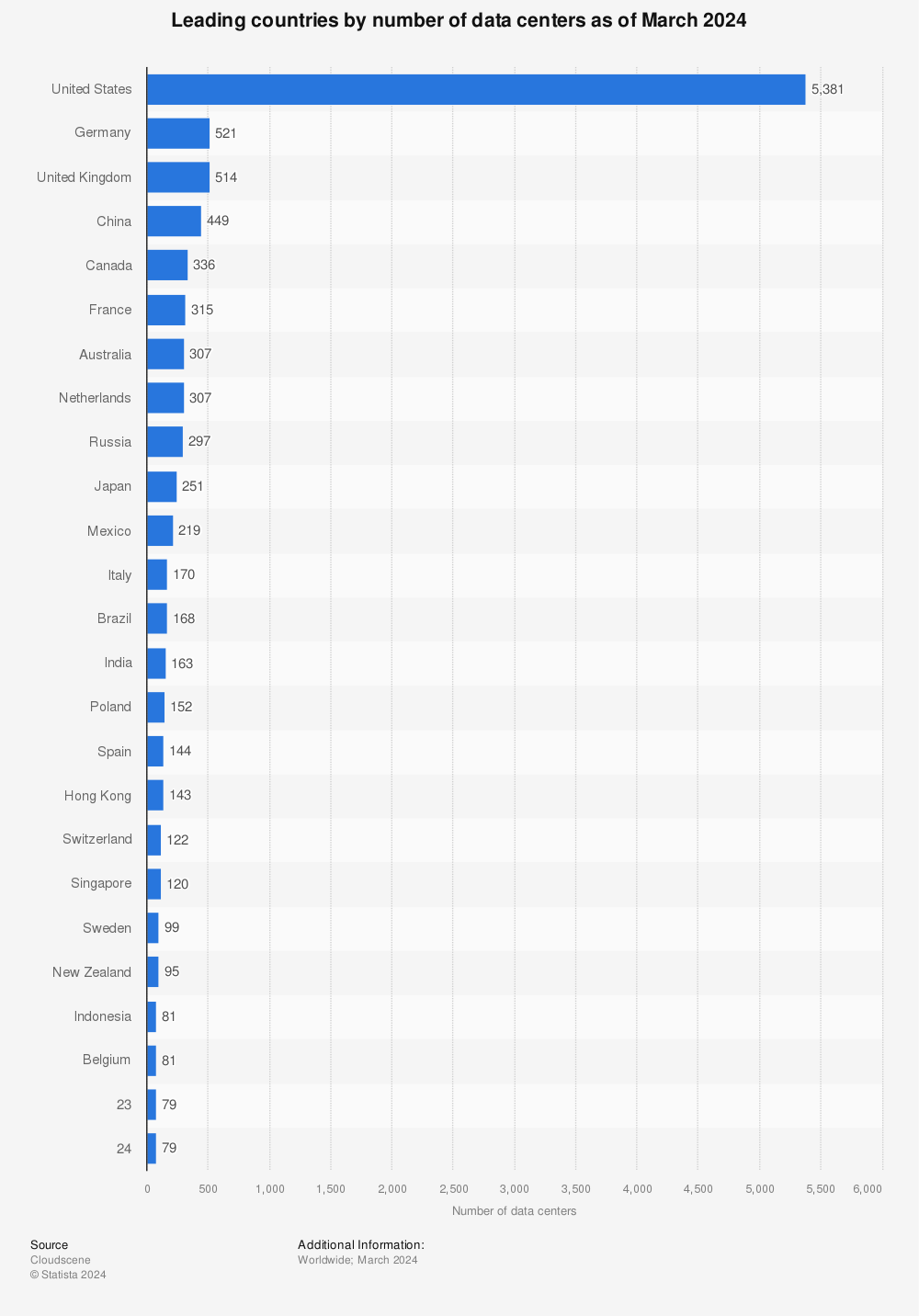
    Number of data centers worldwide 2025, by country or territory

    Mike's Notes

    Provides some perspective on the distribution of their current locations. The 2025 data is available as a spreadsheet. 

    It's also a proxy index of electrification and economic development by country.

    Resources

    References

    • Reference

    Repository

    • Home > Ajabbi Research > Library >
    • Home > Handbook > 

    Last Updated

    25/12/2025

    Number of data centers worldwide 2025, by country or territory

    By: Petroc Taylor
    Statistica: 19/11/2025

    Petroc Taylor is a researcher with Statista's Technology and Telecommunications team. His research focus is global developments in the use of data, including trends in big data, analytics, and storage, as well as the impact of emerging data technologies across industries and sectors. He also supports the team's coverage of operating systems, telecommunications, and the technology industry in Africa..

    As of November 2025, there were a reported 4,165 data centers in the United States, the most of any country worldwide. A further 499 were located in the United Kingdom, while 487 were located in Germany.

    What is a data center?

    Data centers are facilities designed to store and compute vast amounts of data efficiently and securely. Growing in importance amid the rise of cloud computing and artificial intelligence, data centers form the core infrastructure powering global digital transformation. Modern data centers consist of critical computing hardware such as servers, storage systems, and networking equipment organized into racks, alongside specialized secondary infrastructure providing power, cooling, and security.

    AI data centers

    Data centers are vital for artificial intelligence, with the world’s leading technology companies investing vast sums in new facilities across the globe. Purpose-built AI data centers provide the immense computing power required to train the most advanced AI models, as well as to process user requests in real time, a task known as inference. Increasing attention has therefore turned to the location of these powerful facilities, as governments grow more concerned with AI sovereignty. At the same time, rapid data center expansion has sparked a global debate over resource use, including land, energy, and water, as modern facilities begin to strain local infrastructure.

    Data

    Statistic: Number of data centers worldwide as of November 2025, by country or territory | Statista

    Find more statistics at Statista

    C4 for documenting architecture

    Mike's Notes

    Pipi is highly complex, with a novel architecture that resembles a moving biological cell, so diagramming to aid understanding will be very challenging.

    The C4 model by Simon Brown may be a valuable tool for Pipi to automatically document itself because it follows simple rules and can zoom in and out. Many other tools will also be needed. Some may have to be invented.

    Chris Richardson's diagrams look useful as well.

    Resources

    References

    • Reference

    Repository

    • Home > Ajabbi Research > Library >
    • Home > Handbook > 

    Last Updated

    23/12/2025

    C4 for documenting architecture

    By: Simon Brown
    C4: 23/12/2025

    I'm the author of Software Architecture for Developers; a developer-friendly guide to software architecture, technical leadership and the balance with agility. I'm also the creator of the C4 software architecture model and the founder of Structurizr, a collection of tooling to help software teams visualise, document and explore their software architecture.

    Ask somebody in the building industry to visually communicate the architecture of a building and you’ll be presented with site plans, floor plans, elevation views, cross-section views and detail drawings. In contrast, ask a software developer to communicate the software architecture of a software system using diagrams and you’ll likely get a confused mess of boxes and lines … inconsistent notation (colour coding, shapes, line styles, etc), ambiguous naming, unlabelled relationships, generic terminology, missing technology choices, mixed abstractions, etc.

    As an industry, we do have the Unified Modeling Language (UML), ArchiMate and SysML, but asking whether these provide an effective way to communicate software architecture is often irrelevant because many teams have already thrown them out in favour of much simpler “boxes and lines” diagrams. Abandoning these modelling languages is one thing but, perhaps in the race for agility, many software development teams have lost the ability to communicate visually.

    Maps of your code

    The C4 model was created as a way to help software development teams describe and communicate software architecture, both during up-front design sessions and when retrospectively documenting an existing codebase. It’s a way to create “maps of your code”, at various levels of detail, in the same way you would use something like Google Maps to zoom in and out of an area you are interested in.

    System Context

    A system context diagram provides a starting point, showing how the software system in scope fits into the world around it.

    Container Diagram

    A container diagram zooms into the software system in scope, showing the applications and data stores inside it.

    Component Diagram

    A component diagram zooms into an individual container, showing the components inside it.

    Code Diagram

    A code diagram (e.g. UML class) can be used to zoom into an individual component, showing how that component is implemented at the code level.

    Uses and benefits

    Good software architecture diagrams assist with communication inside and outside of software development/product teams, efficient onboarding of new staff, architecture reviews/evaluations, risk identification (e.g. risk-storming), threat modelling, etc. The goal of the C4 model is to raise the level of maturity associated with software architecture diagrams.

    Visualising software architecture with the C4 model - Simon Brown, Agile on the Beach 2019

    Long live the aeonophiles!

    Mike's Notes

    Fascinating extreme example of thermodynamics of life pushing systems out of equilibrium.

    Resources

    References

    • Reference

    Repository

    • Home > Ajabbi Research > Library > Subscriptions > Aeon
    • Home > Handbook > 

    Last Updated

    7/01/2026

    Long live the aeonophiles!

    By: Karen G Lloydis
    Aeon: 18/12/2025

    Karen G Lloydis a microbial biogeochemist, focused on discovering and describing life inside Earth’s crust. She is the Wrigley professor of earth sciences, and marine and environmental biology, at the University of Southern California, and the author of Intraterrestrials: Discovering the Strangest Life on Earth (2025)..

    The discovery of organisms that have been alive for many thousands of years requires a revolution in how we understand life

    Promethearchaeum syntrophicum, strain MK-D1, digitally coloured yellow, strain MK-D1. Courtesy Hiroyuki Imachi, Masaru K Nobu, and JAMSTEC

    If you had to nominate the slowest, longest-living organisms on Earth, what would you picture? Among the vertebrates, some people might think of tortoises, whales or perhaps more obscure creatures like the Greenland shark, which can live for centuries. Others might imagine coral colonies, or perhaps an ancient tree: there are oaks in England that could be more than 1,000 years old, whereas in California, a few Bristlecone pines have been around for millennia, dating to around the formation of ancient Egypt.

    But how about bacteria? Microbes, at the outset, may seem unsuitable candidates for the title of longest-living organism, since we’re so used to experiencing how they grow (and die) so quickly. If I wake up with a tickle in my throat, I get a feeling of dread because I know that, by the evening, I’m going to have a full-blown case of strep throat – the bacterial cells dividing like wildfire in my body. Some bacteria, like E coli, can double every 20 minutes. They can be killed off just as quickly, when faced with antibiotics or disinfectant.

    However, E coli and other fast-replicating microbes don’t live in subsurface environments, where the conditions are ripe for a far more languid pace. In recent years, my fellow biologists and I have assembled evidence suggesting that the microbial world deep beneath the ground may be far slower than we think – perhaps remaining metabolically active for millions of years. I call these organisms aeonophiles – and by living as long as they do, they are rewriting the rules of biology itself. What are they doing down there? It turns out they might be waiting – waiting to return to the surface. But unlike cicadas or hibernating bears, these living things are holding on for events that might take centuries, millennia or even geological eras to arrive.

    The steps that led to our discovery of this strange life can be traced back to advances in DNA technology in the 1980s. For the first time, biologists could sequence the DNA from microbes directly, in any environment, without first growing these microbes in a laboratory. In 1998, Philip Hugenholtz, Norman Pace and colleagues at the University of California, Berkeley used this new technology to discover 12 deep branches on the tree of life in a Yellowstone National Park hot spring. The next year, Costantino Vetriani and Anna-Louise Reysenbach at Rutgers University in New Jersey and colleagues discovered even more new groups in deep-sea mud. None of these organisms had parallels in the known world of microbiology; they were entirely new to science. This new DNA-sequencing technology took off like wildfire, and scientists around the world, including myself as a young researcher, started discovering new types of life all over the place.

    What we’ve discovered since has changed our conception of what life is like on Earth. Before these discoveries, it was unknown whether life can exist inside Earth’s crust. We now know that there is life under our feet, way under our feet. These subsurface-dwelling single-celled organisms are collectively called intraterrestrials, due to their parallels with the mystery and novelty of extraterrestrials. But, unlike space aliens, we know for certain that intraterrestrials exist.

    The author and research team drilling in Svalbard, northern Norway. Photo by Jon Leithe

    Intraterrestrials comprise a vast still-mysterious ecosystem in Earth’s crust containing as many (or more) living microbial cells than are on Earth’s surface. We know this from scientists such as myself going out on scientific drilling ships that sample deep marine sediments or drilling deep into continental crust, laboriously counting the number of cells we find there, and extrapolating out to the rest of the world. The deepest we’ve found intraterrestrials thus far is about 5 km down. That’s deep enough for these intraterrestrials to never see the light of day, nor do they receive much food input from the surface world. Their world is mostly composed of tiny spaces between sediment grains or miniscule fractures in rocks. Rocks seem solid to us, but to very tiny life, rocks appear porous, with lots of places to live. From the few growing cultures that we have of these organisms, we know that many of them are tiny, and some have long appendages, such as the Asgard archaea and the Altiarchaeales, which may help them to hang on to their rock or sediment housing.

    The intraterrestrial Lokiarchaeum ossiferum (‘skeleton-carrying’) is a member of the Asgard phylum, so named after Norse mythology because some of the first examples were found near the hydrothermal vent field Loki’s Castle in the Arctic Ocean. Its skeleton is probably a hallmark of Asgard archaea. Courtesy Rodrigues-Oliveira et al

    Although deep geological sources of food and nutrition (often in the form of deep gases and hydrothermal fluids) can support life in some parts of the subsurface, thousands of years or longer might pass with little to no food inputs. This extreme scarcity has extraordinary implications for life. In much of this vast biosphere, there’s not enough energy to drive microbial cell division at anything like a normal rate. Before discovering these organisms, we had a narrower view of how much energy life requires and how long a single organism can stay alive.

    But how long can a cell live like this? Theoretically, there’s no limit

    The intraterrestrials are showing us that we were wrong; life can exist on orders of magnitude lower power and sustain their living cells for orders of magnitude more years than previously thought possible. This means that many of these living beings bump up against the energetic limits of life, and in the process seem to have cracked the code for near-immortality. These types of intraterrestrials have such extremely long lifespans that we need a new term to describe the type of extremophiles that they are. The word aeonophiles fits, since they like (-phile) long periods of time (aeon-). (If they could read, I’m sure they’d be die-hard subscribers to Aeon magazine too.)

    Members of the Asgard archaea (left) were first collected from the Loki’s castle hydrothermal vent in the Arctic ocean in 2008. They include Lokiarchaeota, Thorarchaeia, Odinarchaeia and Heimdallarchaeia. Courtesy Wikipedia

    Many of these aeonophile types of intraterrestrials survive on thousands of times lower power than the amount required to maintain a next-to-dead non-growing culture of normal bacteria. This means that even though the deep subseafloor is one of the largest ecosystems on Earth, hardly any of the microbes that live there are actually growing. They have 0.00001 per cent of the power that supports all other known types of cell growth on Earth, so even performing a single cell division is impossible.

    Candidatus Altiarchaeum hamiconexum cells within their biofilm. Cells appear fluffy due to their extracellular polymeric matrix and cell-surface appendages (‘hami’). Courtesy Probst and Moissl-Eichinger

    Aeonophiles funnel all the meagre power that’s available to them into replacing broken body parts, not dividing into two new daughter cells. So, long-term metabolically active dormancy is the only option. But how long can a cell live like this? Theoretically, there’s no limit if it slowly replaces its broken bits over time. This brings up a real conundrum. On the one hand, if anything like immortality were common, then we would be surrounded by beings that were born sometime around the origin of life, which is not the case. But on the other hand, these aeonophiles seem like they could live forever.

    Luckily, there’s a lot of temporal real estate between a 20-minute doubling time and immortality. What if the aeonophiles live for 500,000 years or a million years? The oldest sediments that have not yet metamorphosed into rock are about 100 million years old, so this is an upper limit on the age of an individual cell in marine sediments. Older rocks could have older cells, as long as the rock has not been buried to sterilising temperatures over the course of its journey around our tectonically active planet.

    To us, they look like they’re doing nothing. As an analogy, over a geological timescale, the California coastline is a constantly churning mass of rocks, but on our human timescale, it is stable enough to build a house on, which can be passed on to our grandchildren. These houses must be sound enough to withstand the occasional earthquake, but they will not survive the reorientations of land as they are spun, submerged, and exhumed over the course of a few million years. To think like an aeonophile, we have to grapple with some incomprehensible timescales.

    How did these organisms evolve to stop growing for thousands of years? To answer this, first we might consider what they would experience in their lifetimes. They wouldn’t be concerned about the length of a day. They’re buried so deep that they can’t detect the Sun anyway. They probably wouldn’t even notice the seasons. However, they might care about other, and longer, geological rhythms: the opening and closing of oceanic basins through plate tectonics, the formation and subsidence of new island chains, or new fluid flows brought on by slow cracks opening in Earth’s crust. The biology I was taught in school considered these events to be evolutionary drivers for a species, not an individual. For instance, Charles Darwin’s finches evolved new beak shapes because they had been isolated on an archipelago.

    We know that animals adapt to the daily or yearly rhythms of their environment, but it seems ridiculous to argue that any creature could anticipate tectonic cycles. It may, however, be reasonable for the aeonophiles. An individual that lives for a million years might be evolutionarily predisposed to count on something as slow as island subsidence in the same way that we are evolutionarily predisposed to wait for the Sun to rise tomorrow. To fully understand aeonophiles, we may have to rethink what qualifies as an evolutionary cue.

    You may also wonder: how does evolution work for an organism that seemingly never produces offspring? According to Darwin’s theory of natural selection, these cells must grow and make new progeny to evolve. But how? I don’t think Darwin had nongrowth in mind when he described survival of the fittest. The answer to the question at the beginning of this paragraph lies in the word ‘seemingly’. They’re not producing offspring in the places that we normally look for them, but there has to be a place or time when they do make progeny.

    We need to jailbreak our brains from our implicit assumptions about lifespan

    Luckily, we have a good model in short-term seasonal dormancy, which various surface organisms enter for months before emerging to reproduce. Here dormancy during winter has an evolutionary advantage: by avoiding harsh, cold conditions, dormant organisms get the chance to have larger populations than non-dormant organisms in the spring. This provides a head start, allowing them to pass along their dormancy genes to a larger population of progeny. Textbook Darwinian natural selection.

    To imagine dormancy that lasts for thousands of years, we have to think of an event that aeonophiles could possibly be waiting for. If we encounter a dormant microbe in soil in winter, we can presume that it’s holding out for summer. What is the equivalent situation for a deeply buried marine sediment organism waiting for thousands to millions of years?

    Before we answer that question, let’s first consider a thought experiment to jailbreak our brains from our implicit assumptions about lifespan. Imagine human lives lasted only 24 hours. You’d be born at midnight, rebel against your parents at breakfast, settle down and have babies just before lunch, and pick up fishing as a retirement hobby around dinnertime. By midnight, your loved ones, who themselves were born only a few hours ago, would huddle close and hold your hand as you’d pass away peacefully at the ripe old age of a day. If everyone did that, hundreds of human generations would come and go within a single winter. Throughout that time span, which would represent a significant chunk of human history, the deciduous trees would remain brown and lifeless. The permanent deadness of trees would be taken as an undisputed fact, and scientists like me would probably apply for grants to understand whether or not trees are alive, given that they don’t seem to grow or make progeny. Of course, if you stretched back far enough, humans would have been present for the fall or even summer, but that might have been so many generations back that a stable form of writing had yet to be invented. We 100-year-lifespan humans know that trees are just waiting to take advantage of the summer sun. But the day-lifespan humans would be stumped.

    When we think about life in the subsurface, are we like day-lifespan humans contemplating a tree? Are long-lived aeonophiles waiting for wake-up cues we don’t recognise because our lives are too short to see them? What is even the point of living for hundreds of thousands of years anyway? There must be some reason these aeonophiles stick around so long.

    Seasonal cycles are way too fast. The only things slow enough are geological processes. For instance, island subsidence, floods or droughts often occur on 100- to 1,000-year cycles. Submarine landslides, earthquakes, tsunamis and volcanic eruptions might shift materials around on even longer timescales, exposing aeonophiles to new food sources that coax them out of dormancy after hundreds of thousands of years. It seems odd to say that a microbe is adapted to wait for something as infrequent as a volcanic eruption, but you can rely on them to happen, as long as you’ve got time to wait.

    The author taking samples from a gassy deep subsurface spring. Photo by Jacopo Pasotti

    If we really let our imagination run wild, individual microbes might be adapted to events with even longer periods, like interglacial cycles, which shift every 30,000 years or so. Or the slow movement of tectonic plates. As a new seafloor pops up in midocean ridges, the existing seafloor is constantly pushed from the middle of the ocean, until it eventually jams into a continent in the slowest-motion train wreck ever.

    Some marine sediments – and the aeonophiles that live in them – will get dragged down on the subducting plate and destroyed. Even for extremophiles, the mantle is an evolutionary dead end. However, some seafloor sediments survive these collisions – rather than subducting, they are scraped off and shoved onto a continental plate. Could all this piling up, faulting and burbling up to the surface be what the aeonophiles are waiting for? Is this an aeonophiles’ version of summer?

    Living on human timescales, it’s hard to say for certain. However, we do know that the aeonophiles are showing us that some Earthlings can live for many thousands of years or longer. In my opinion, these are fundamental discoveries about the nature of life on Earth. In fact, I believe that the discovery of ultra-long-lived creatures is up there with the discovery of hyperthermophiles, microbes that thrive at temperatures above the boiling point of water. When hyperthermophiles were discovered in the 1960s, it blew open our understanding of where life might exist in the Universe. I foresee a similar seismic shift from the discovery of aeonophiles.

    The existence of such organisms greatly expands the window of time during which we can look for biomarkers in the cosmos. In fact, they raise the troubling possibility that, if life on other planets is extremely slow, it might also be nearly impossible to detect. As we examine other planetary bodies, we look for changes that might signify that something is alive and doing work on that planet. But if that life is extremely slow, we may not realise we’re looking at it because it doesn’t change much while we’re observing it. It is not impossible that beneath the surface of Mars or Europa, things are alive and functioning much more slowly than the life that we’re used to.

    By living as slow as they do, aeonophiles prompt us to consider how we define life and non-life. How can we scientifically distinguish between the two? For answers, I believe we need to think of life, in its most basic function, as an energetic phenomenon. And to do that, it’s necessary to look at it through the lens of thermodynamics.

    In their book Into the Cool (2005), the scientist Eric Schneider and the writer Dorion Sagan suggest that life and non-life exist in a continuous line. At one end of the spectrum are non-living systems at energetic equilibrium; and at the other end are living systems continuously creating further energetic potential to make sure they stay well out of equilibrium. So, one way to define life would be that it is good at creating energetic opportunities to push things far out of equilibrium.

    If we’re talking about energy, we have to talk about the second law of thermodynamics, which is driving it all. The law says that, in a closed system, entropy – roughly the number of ways a system can be arranged – tends to increase overall. As entropy rises, less of a system’s energy can be used to do work. We’ve long known that life is good at producing entropy; just look at the heat radiating from our bodies and even whole cities. Non-life can produce entropy too, though, so how does this help us tell the difference?

    Aeonophiles show us that life has more creative ways of producing entropy than we thought possible

    According to non-equilibrium thermodynamics, it is life’s propensity for continually pushing systems back out of equilibrium that sets it apart from non-life. Once things are well out of equilibrium, entropy can be produced in the race to regain equilibrium. Crucially, life seems to be better than non-life at creating new systems in which entropy can be produced. An eddy in a stream is not alive, but for a short amount of time, the water molecules become a whirlpool to maximise entropy production through energy dissipation from the system. Life does this too, but it’s more sophisticated and effective in its approach. Non-life makes whirlpools, but life dams the river to go whitewater rafting on those whirlpools. Non-living asphalt heats up when sunlight hits it, creating a bit of entropy, but a rainforest places leaves at different levels capturing every last photon of light and turning it into biomass that will support an entire ecosystem of animals and fungi that produce more entropy per ray of light than asphalt ever could.

    What the aeonophiles do for us is to show us that life has more creative ways of producing entropy than we previously thought possible. If the point of life is to create more entropy by spreading out its production over increasingly large scales of space and time, then this task seems tailor-made for aeonophiles. Simply by living for aeons, they may stretch out entropy production for longer timescales, maximising its final tally for the second law. Finding such an outlandish new way to create opportunities for entropy production supports the idea that this opportunity for entropy creation is, itself, the why of life. In short, life happens because the second law of thermodynamics demands it. And the aeonophiles, by their very long-lived existence, drive that point home for us.

    Even though they may seem extraordinary to us, individuals that live for thousands of years or longer may be ordinary on Earth. In addition to showing us that life is far more diverse than we thought, and can use energy and time in ways we would never have dreamed up on our own, aeonophiles might be key to understanding why life exists. They’re showing us new ways for life to conduct its delicate dance with energy and entropy. As we continue to learn more about these strange intraterrestrials, and the aeonophiles among them, I believe we will continue smashing our preconceived notions of how life itself is supposed to work, one barely breathing cell at a time.

    Just magic - working on Globe for Magiciens de la Terre

    Mike's Notes

    I was talking with Chuheng in an online meeting yesterday about the Pipi origin story.

    I ended up explaining how I work things out visually, like an artist, not like an engineer.

    Working for NZ Sculptor Neil Dawson was one of those formative experiences that taught me to work consciously like an artist. Daydreaming and intuition with deadlines, not plans. Just making it up on the day, letting go of the handrails. Initially, I found it difficult; I had been a skilled tradie in heavy engineering, used to fabricating big, complex, expensive structures perfectly.

    I discovered, in the course of the Globe project described below, how to consciously create a rich model in my head, work from it, and keep doing so. I still have that model and can fly around in it whenever I want to. The same goes for the thousands of other models floating around in my brain since age 4.

    So what has this got to do with Pipi? The truth is, I built up all the internal layers in Pipi one on top of another, like making an oil painting, a film, or a magnificent, tasty dish. A dash of this, a smidgen of that. It has become a Complex Adaptive System. I can see the whole, but the swirling parts connect, and I have no idea how to describe why it works, because its properties emerge from the interactions of the parts. There are hundreds of agents, each with multiple copies, and they self-assemble in different ways at different times. I can't even draw it as it adapts and grows. I suspect I just got lucky. Anyway, it works.

    That might be why new, unexpected properties of Pipi keep getting discovered.

    That is also why Pipi must generate its own documentation, because I can't anymore.

    And that is why Pipi 9, working with a human, will generate Pipi 10 when it is ready and needs to.

    Resources

    References

    • Barr, Jim; Barr, Mary (1989). Neil Dawson: Site Works 1981–1989. Wellington, New Zealand: National Art Gallery

    Repository

    • Home > Ajabbi Research > Library >
    • Home > Handbook > 

    Last Updated

    03/02/2026

    Just magic - working on Globe for Magiciens de la Terre

    By: Mike Peters
    Redworks: 19/08/2010

    Mike is the inventor and architect of Pipi and the founder of Ajabbi.

    From late 1987, I had the wonderful opportunity to work for Neil Dawson, a Christchurch-based sculptor who exhibits worldwide.

    I was employed as a sculptor's assistant. I got to act as his hands, and it was just fantastic. Every morning when I came in to start work, there would be a pile of A4-sized drawings he had done the night before—any of which could have become a work of art. Occasionally, I was given a drawing and told to go off and make it, or several identical copies. I then realised what "Michelangelo being a factory" meant.

    Neil was a really nice chap to work for, very talented, and he taught me a lot by personal example.

    From memory, work started on Globe about mid-1988. It was to be hung above the plaza outside the Centre Georges Pompidou in Paris as part of the exhibition Magiciens de la Terre.

    First, a small Marquette was made out of beaten metal mesh and presented with location photos.

    Bruce Edgar, Neil's technical wiz, found a way to make this impossible object possible through investigations and material trials. Richard Reddaway made a 60cm sphere for a working drawing.

    spent two weeks at the University of Canterbury Geography Department watching all of the satellite imagery available. I remember being mesmerised by time-lapse movies lasting months, showing swirling patterns of clouds moving across the planet. There were also books with photos taken by astronauts. It was just stunning!

    In an interview, I said, 

    "We originally started off projecting photos onto the surface of the sphere and then accurately trying to trace them on. Every little dot and speck, and then going through and editing that. But it was too mechanical, so now it is being done in quite a sort of painterly way - I just try to put in the general sweeps and swirls and then put lots of resolution in. I noticed that all the scientists have got books and books and books on dissecting the weather, but they have no beautiful pictures of what it actually looks like. It's really very interpretive - a funny situation, really - sort of like a ghost painter. I'm painting the world as I see it and Neil comes along and edits it. It's his choice."


    The model was then photographed and projected onto a series of hexagon plates made of foam fibreglass composite, eventually bolted together to make a 4.5-meter hollow sphere suspended 25 meters above the Pompidou Plaza.

    I traced photos and then cut them out with a router. I can still remember the fibreglass dust and the breathing gear.

    I think six people were involved in making Globe. It was carefully assembled and hung from the rafters in Neil's studio. Neil spray-painted it—he did an amazing job—just perfect.

    Then Neil and Bruce went to Paris to put it up.

    The whole thing was a great experience. After the exhibition, it went to a gallery in New Plymouth and to an outdoor gallery in Australia, where it was eventually destroyed in a storm.

    Looking back, Neil showed incredible guts tackling this project. Everyone worked very hard, and technology was at its limit. It was an honour to be part of it.


    Workspaces have settings

    Mike's Notes

    This is where I will keep detailed working notes on creating Workspaces > Settings. Eventually, these will become permanent, better-written documentation stored elsewhere. Hopefully, someone will come up with a better name than this working title.

    This replaces the coverage in Industry Workspace dated 13/10/2025.

    Testing

    The current online mockup is version 1 and will be updated frequently. If you are helping with testing, please remember to delete your browser cache so you see the daily changes. Eventually, a live demo version will be available for field trials.

    Why

    (To come).

    Resources

    References

    • Reference

    Repository

    • Home > Ajabbi Research > Library >
    • Home > Handbook > 

    Last Updated

    21/12/2025

    Workspaces have settings

    By: Mike Peters
    On a Sandy Beach: 21/12/2025

    Mike is the inventor and architect of Pipi and the founder of Ajabbi.

    Open-source

    This open-source SaaS cloud system will be shared on GitHub and GitLab.

    Dedication

    This workspace is dedicated to the life and work of .

    Person

    Source: 

    " - Wikipedia

    Change Log

    Ver 1 includes .

    Existing products

    Features

    This is a basic comparison of features in settings software.

    [TABLE]

    Data Model

    words

    Database Entities

    • Facility
    • Party
    • etc

    Standards

    The workspace must comply with all applicable international standards.

    • (To come)

    Support

    There will be extensive free documentation sets tailored for different users.

    Every user account includes access to customer support when using these modules (which can be enabled or disabled in account settings). 

    Workspace navigation menu

    Every user account includes account settings.

    Modules with descriptions

    • Settings
      Settings dashboard.
      • Account
        Account settings.
      • Billing
        Usage, payments, plan.
      • Deployment
        Deployment options, including language.
        • Workspace
          Choice of workspaces.
          • Module
            Choice and arrangement of modules.
          • Plugin
            Usage of plugins.
          • Template
            Application of templates to pre-configure the workspace.
        • Users
          Users of the workspace, RBAC.

    Workspace navigation menu

    This default outline needs significant work. The outline can be easily customised by future users via drag-and-drop and tick boxes to toggle features on and off.

    • Generic User Account
      • Applications
      • Customer
      • Settings
        • Account
        • Billing
        • Deployments
          • Workspaces
            • Modules
            • Plugins
            • Templates
              • (To come)
            • Users

    Bayesian Statistics

    Mike's Notes

    A great introduction to Bayesian Statistics. With example workbooks. All free, including an Excel Resource Pack. The Real Statistics website by Charles Zaiontz is a fantastic resource.

    Update

    The YouTube lesson by Vivek Vinushanth Christopher is superb.

    Resources

    References

    • Reference

    Repository

    • Home > Ajabbi Research > Library >
    • Home > Handbook > 

    Last Updated

    24/01/2026

    Bayesian Statistics

    By: Charles Zaiontz
    Real Statistics: 01/05/2021

    Dr. Charles Zaiontz has a PhD in mathematics from Purdue University and has taught as an Assistant Professor at the University of South Florida as well as at Cattolica University (Milan and Piacenza) and St. Xavier College (Milan).

    Bayesian statistics uses an approach whereby beliefs are updated based on data that has been collected. This can be an iterative process, whereby a prior belief is replaced by a posterior belief based on additional data, after which the posterior belief becomes a new prior belief to be refined based on even more data. The initial prior belief in this series may be based on intuition, previous studies, experience, etc.

    In inferential statistics, we commonly test hypotheses, estimate parameters, and make predictions. In the traditional approach to statistics, commonly called the frequentist approach, parameters are constants whose values we aim to discern. Bayesian statistics uses a different approach: we treat these parameters as variables that have a probability distribution.

    Topics

    References

    1. Gelman, A., Carlin, J. B., Stern, H. S., Dunson, D. B., Vehtari, A., Rubin, D. B. (2014) Bayesian data analysis, 3rd Ed. CRC Press
      https://statisticalsupportandresearch.files.wordpress.com/2017/11/bayesian_data_analysis.pdf
    2. Marin, J-M and Robert, C. R.  (2014) Bayesian essentials with R. 2nd Ed. Springer
      https://www.springer.com/gp/book/9781461486862
    3. Jordan, M. (2010) Bayesian modeling and inference. Course notes
      https://people.eecs.berkeley.edu/~jordan/courses/260-spring10/lectures/index.html
    4. Lee, P. M. (2012) Bayesian statistics an introduction. 4th Ed. Wiley
      https://www.wiley.com/en-us/Bayesian+Statistics%3A+An+Introduction%2C+4th+Edition-p-9781118332573

    Workspace Engine modifications

    Mike's Notes

    A progress report on recent work.

    Resources

    References

    • Reference

    Repository

    • Home > Ajabbi Research > Library >
    • Home > Handbook > 

    Last Updated

    19/12/2025

    Workspace Engine  modifications

    By: Mike Peters
    On a Sandy Beach: 19/12/2025

    Mike is the inventor and architect of Pipi and the founder of Ajabbi.

    The required workspace modifications have been successfully carried out following user testing in November.

    Workspace Engine (wsp)

    The model inside the Workspace Engine (wsp) has been successfully populated and modified. This had led to a cascading ripple effect on other (agent) engines.

    • Namespace changes for event source messaging
    • One object model
    • Config hierarchy
      • Default industry settings
      • User Account settings
      • Personal preference view settings

    CMS Engine (cms)

    Additional records describing the workspace config were added.

    • Menu navigation from object model
    • Menu layout options
      • Ribbon (default)
      • Flyout
      • Side Nav
    • Dashboard blocks added to Component Classes

    Workflow Engine (wfl)

    • Binding to Ribbon controls

    Deployment Engine (dpl)

    • Workspace Modules are now specific to deployment types
    • Namespace changes for event source messaging

    User Account Engine (usr)

    • Workspace Modules are now specific to account types
    • Namespace changes for event source messaging